Your website is your hardest-working salesperson. It is open 24 hours a day, 7 days a week, fielding inquiries, building trust, and either converting visitors into leads or losing them to a competitor whose site does a better job. In 2026, the gap between websites that convert and websites that leak opportunity comes down to one thing more than any other: artificial intelligence.
AI is no longer a feature reserved for enterprise companies with seven-figure technology budgets. The tools, frameworks, and implementation pathways that once required a team of engineers can now be built and integrated by a skilled development partner for businesses of any size. The businesses adding AI features to their websites in 2026 are not doing it because it is trendy. They are doing it because it works, and because their competitors who have not done it yet are leaving real money on the table.
At Webtechnality, we have spent the last two years building AI-powered features into business websites across industries. This is the definitive list of what actually moves the needle.
A 2026 Salesforce research report found that businesses using AI features on their websites report a 32% higher visitor-to-lead conversion rate and a 44% reduction in cost-per-acquisition compared to businesses using websites built without AI capabilities.
What Separates a 2026 Website from a 2022 Website
Before we get into the feature list, it is worth grounding this conversation in what has actually changed. A well-designed website from 2022 could look beautiful, load quickly, and rank decently in search. But it was fundamentally passive. It waited for visitors to act and then tried to capture them at the moment of action.
A 2026 website is active and intelligent.
- It reads visitor signals in real time.
- It adapts its content to the person viewing it.
- It qualifies leads automatically.
- It answers questions and resolves issues without a human having to be online.
- It learns from every interaction to improve its next one.
The difference is not cosmetic. It is structural. And it shows up directly in conversion rate, lead quality, customer satisfaction scores, and revenue per visitor.
The 10 AI Website Features Every Business Needs in 2026
1. Predictive Lead Scoring
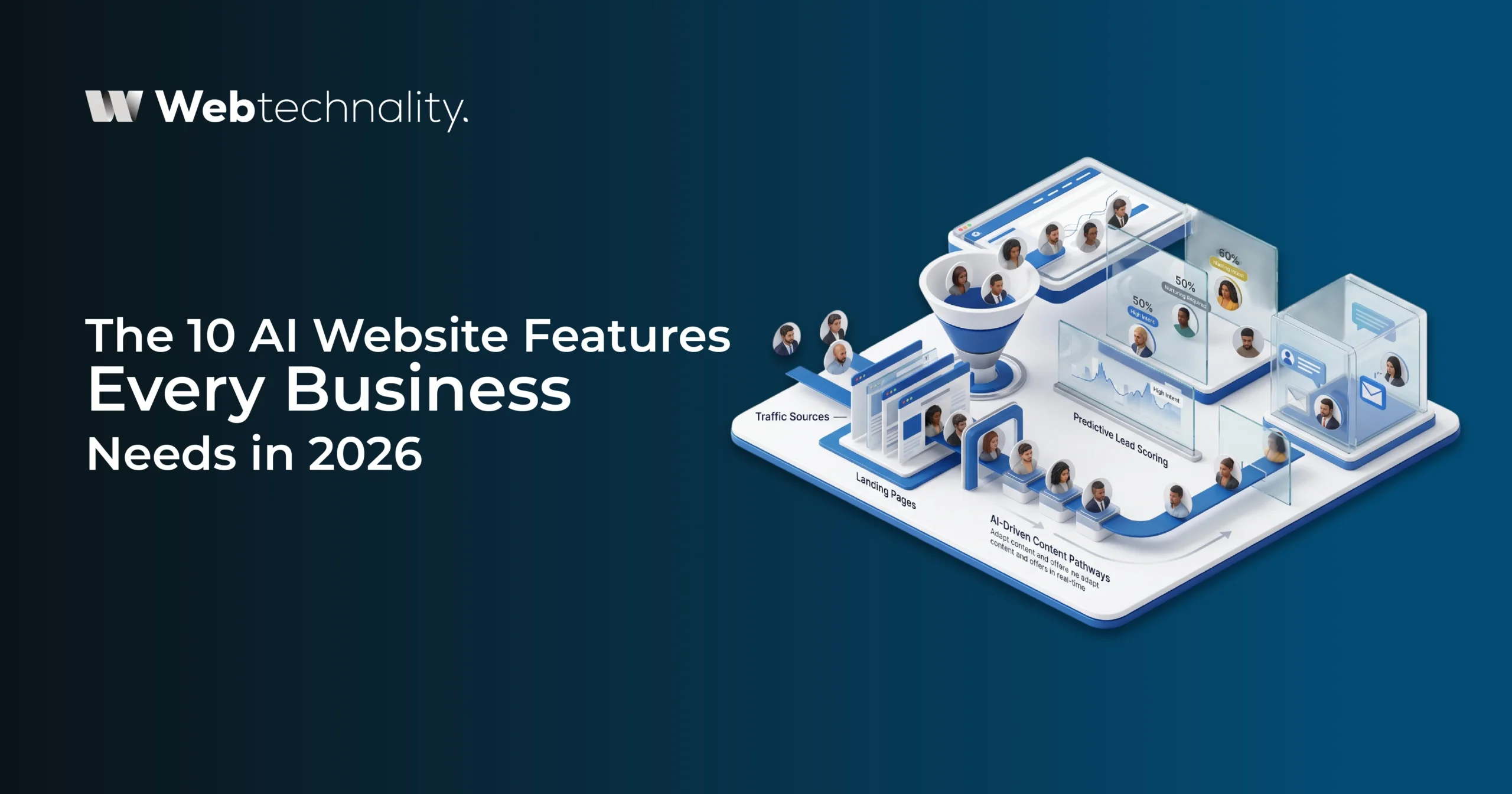
Every visitor to your website leaves behavioral signals that reveal their level of purchase intent. Predictive lead scoring uses machine learning to analyze these signals in real time and rank every lead by conversion probability. Your sales team stops working equally hard on every inquiry and starts focusing their best energy on the leads most likely to close. For any business generating more than 50 leads per month, this is the highest-ROI AI feature available. Learn more in our dedicated guide on predictive lead scoring.
2. AI-Powered Chat Agent (Not Just a Chatbot)
There is a meaningful difference between a chatbot and an AI agent. A chatbot follows scripts. An AI agent reasons through problems, queries your live systems, and resolves issues. Deployed on your website, a properly built AI agent handles product questions, qualifies leads, books appointments, processes common requests, and escalates complex issues to a human with full context already prepared. Available 24 hours a day with no wait time and no inconsistency.
3. Dynamic Content Personalization
Static websites show every visitor the same content regardless of who they are, where they came from, or what they have done before. AI-powered personalization changes this entirely. A returning visitor who previously viewed your enterprise pricing page sees different messaging than a first-time visitor who came from a Google search for small business solutions. Personalized CTAs, headlines, and recommended content consistently outperform static alternatives by 40 to 60 percent in conversion rate testing.
4. AI-Driven Site Search
Traditional site search returns keyword matches. AI-powered search understands intent. A visitor who types “how do I get started” into a site with AI search gets directed to your onboarding page, your introductory service, or your getting started guide rather than a confused list of keyword results. For content-heavy sites, ecommerce stores, and knowledge bases, intelligent site search dramatically improves visitor satisfaction and time-on-site, both of which signal quality to search engines.
5. Automated SEO Content Optimization
AI content optimization tools analyze your existing pages against current search rankings, identify gaps in coverage, flag thin or outdated content, and recommend specific improvements. Integrated into a CMS workflow, this means your website is continuously improving its search performance rather than sitting static between manual audits. At Webtechnality, we integrate these tools as part of our ongoing SEO services in Arizona for clients who want measurable ranking improvement quarter over quarter.
6. Behavioral Analytics and Heatmap Intelligence
AI-enhanced analytics go far beyond page views and bounce rates. They identify exactly where on a page visitors lose interest, which elements they engage with most, which content combinations lead to conversion, and which pages are failing to move visitors further through the funnel. This intelligence makes every design and content decision data-driven rather than assumption-based, compounding your conversion rate improvement over time.
7. AI Product Recommendations
For ecommerce and service businesses with multiple offerings, AI recommendation engines analyze purchase history, browsing behavior, and segment patterns to surface the most relevant next product or service to every individual visitor. Amazon attributes 35% of its revenue to its recommendation engine. The same technology is now accessible at every price point. Upsell and cross-sell rates consistently improve by 20 to 35 percent after implementation.
8. AI-Powered Review and Social Proof Management
AI review tools automatically collect, organize, and display your most relevant testimonials and case studies based on the specific page a visitor is viewing. A visitor on your healthcare services page sees testimonials from healthcare clients. A visitor on your ecommerce page sees retail success stories. Dynamic social proof that matches visitor context consistently outperforms a static testimonials page by a significant margin.
9. Intelligent Form Optimization and Lead Capture
AI form optimization tools analyze submission data to identify which fields are causing abandonment, which form layouts generate the highest completion rates for your specific audience, and which lead qualification questions give your sales team the most useful information. Progressive profiling, where forms ask different questions to returning visitors based on what you already know, dramatically improves both submission rates and lead quality simultaneously.
10. Schema Markup Automation and AI Search Optimization
With AI Overviews and generative search engines now handling over half of all search queries, having complete and accurate structured data across your website is non-negotiable. AI-powered schema tools automatically generate and maintain the correct markup for every page type, ensuring your site remains readable and citable by AI search engines as your content grows and evolves. This is the technical foundation of your visibility in AI-driven search results.
Which Features to Add First
Not every business should add all ten features at once. The right starting point depends on your business model, current traffic volume, and primary revenue bottleneck. Here is the prioritization framework we use with clients:
- If your biggest problem is lead quality: Start with predictive lead scoring and intelligent form optimization.
- If your biggest problem is conversion rate: Start with dynamic personalization and behavioral analytics.
- If your biggest problem is customer support load: Start with an AI chat agent.
- If your biggest problem is organic traffic: Start with schema automation and automated SEO content optimization.
- If you run an ecommerce store: Start with AI product recommendations and intelligent site search.
The goal is to solve the highest-cost problem first, generate ROI quickly, and use that momentum to fund and justify the next feature addition. This approach consistently outperforms trying to implement everything at once, which typically leads to delayed timelines and diffused impact.
AI Feature ROI at a Glance
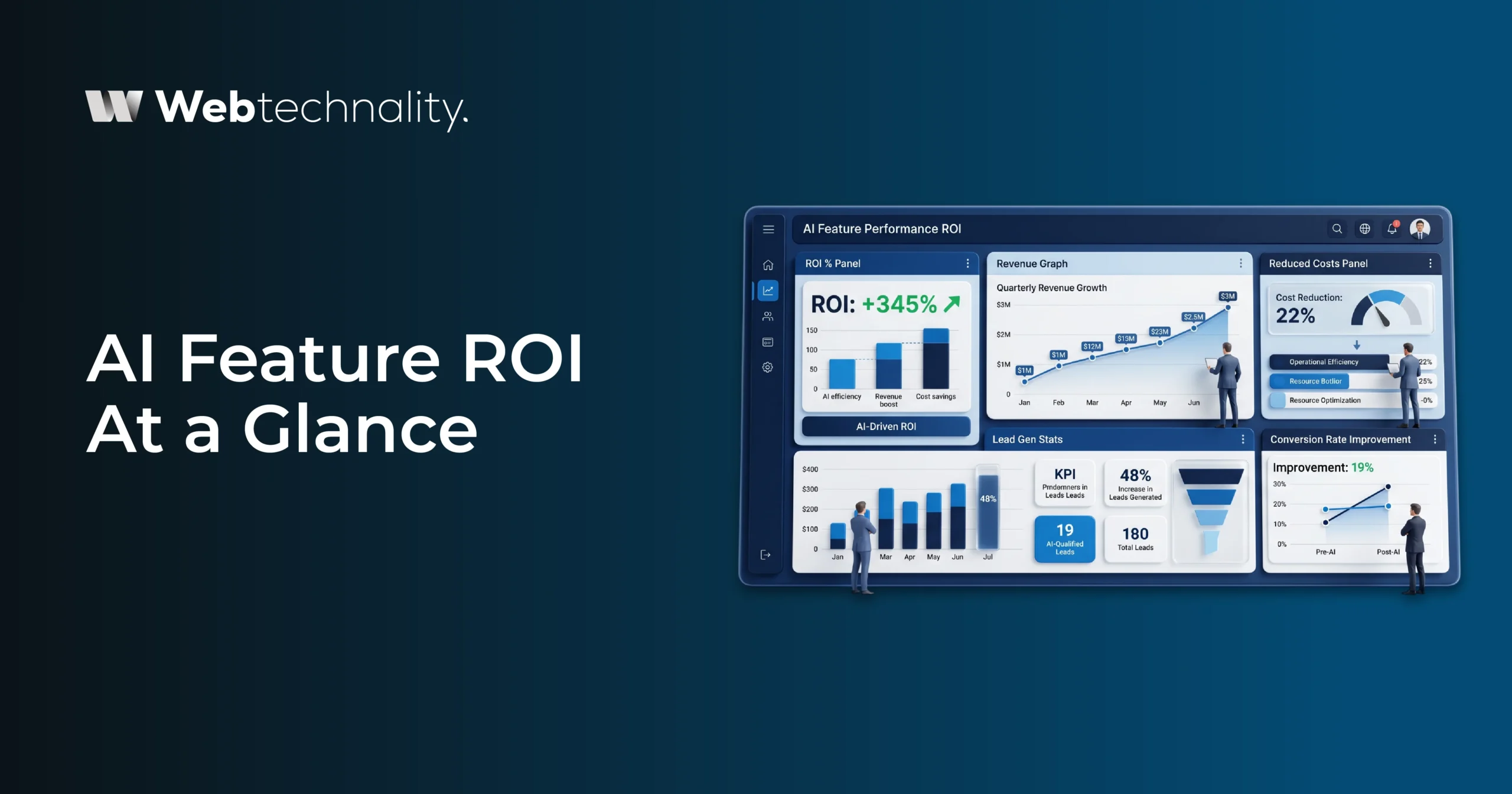
| AI Feature | Primary Benefit | Typical ROI Timeframe | Best For |
|---|---|---|---|
| Predictive Lead Scoring | +20–40% close rate | 30–60 days | B2B, high-volume lead gen |
| AI Chat Agent | 24/7 resolution, reduced support cost | Immediate | All businesses |
| Dynamic Personalization | +40–60% CTA conversion | 30–45 days | SaaS, services, ecommerce |
| AI Site Search | +25% time on site | Immediate | Content-heavy, ecommerce |
| SEO Content Optimization | Consistent ranking improvement | 60–90 days | All businesses with blogs |
| AI Recommendations | +20–35% upsell revenue | 30 days | Ecommerce, multi-service |
| Schema Automation | AI search visibility | 14–30 days | All businesses |
Frequently Asked Questions
What are the most important AI features for a business website in 2026?
The highest-impact AI features for business websites in 2026 are predictive lead scoring, AI-powered live chat and resolution agents, dynamic content personalization, intelligent site search, AI-driven SEO optimization, and automated schema markup. Together, these features convert more visitors and surface more qualified leads from your existing traffic.
How much does it cost to add AI features to a website?
Cost varies significantly by feature and implementation approach. Some AI features like intelligent site search or basic chat can be added as integrations for a few hundred dollars per month. Custom predictive lead scoring systems and full AI agents typically require a development investment of several thousand dollars. Webtechnality scopes each project based on your specific goals and existing infrastructure.
Do AI website features require rebuilding my entire website?
No. Most AI features can be added to an existing website through API integrations, embedded scripts, or modular feature additions. A complete rebuild is only necessary when the existing platform lacks the technical foundation required for certain advanced features. Webtechnality assesses your current platform before recommending an approach.
What is AI personalization on a website?
AI website personalization uses behavioral data, firmographic information, and visitor history to dynamically change what content, offers, and calls-to-action a visitor sees. Returning visitors see content relevant to where they are in the buyer journey. First-time visitors from specific industries or geographies see messaging tailored to their context.
Are AI chatbots and AI agents the same thing?
No. AI chatbots use scripted decision trees or basic language matching to respond to visitor input. AI agents use large language models and reasoning frameworks to understand intent, query live systems, and take real actions. AI agents provide significantly higher resolution rates on complex customer inquiries and handle a much broader range of scenarios.
How long does it take to see results from AI website features?
Most businesses see measurable improvements in lead quality, conversion rate, or support resolution time within the first 30 to 60 days. Full impact from features like predictive lead scoring typically emerges over 60 to 90 days as the model accumulates sufficient conversion data to make accurate predictions.
Can Webtechnality add AI features to my existing website?
Yes. Webtechnality integrates AI features into existing websites across all major platforms, including WordPress, Shopify, custom-built sites, and more. We assess your current infrastructure, recommend the highest-ROI features for your business goals, and handle the full implementation from design to deployment.
The Bottom Line
A website without AI in 2026 is like a retail store without any staff. It is there, the shelves are stocked, but no one is helping customers find what they need, qualifying who is ready to buy, or following up when a visitor leaves without converting.
The businesses that add these AI features are not just getting marginal improvements. They are creating compounding advantages that grow larger every month as their systems learn, adapt, and continuously improve on their own.
Start Here:
- Identify your biggest conversion bottleneck: leads, quality, support, or organic traffic
- Choose one or two features from this list that directly address that bottleneck
- Assess your current platform for the integrations each feature requires
- Set measurable success metrics before you build conversion rate, lead quality score, and resolution rate
- Partner with a development team that has built these systems before and can deliver a timeline, not just a proposal
About Webtechnality
Webtechnality is a full-service digital agency in Kingman, Arizona, specializing in AI development, web design, ecommerce, and digital marketing. With 10+ years of experience and 5,000+ projects delivered, we help businesses build websites that are intelligent, fast, and built to grow.