Your website is the center of gravity for everything your business does online. It is where your ads send traffic, where your social media followers end up, where potential clients form their first impression of you, and where leads either convert or walk away forever. Choosing the company that builds this asset is one of the most consequential vendor decisions a business owner makes.
And yet most business owners make this decision the wrong way. They look at a portfolio of attractive websites, receive a few quotes, pick the one that seems most reasonable, and hope for the best. That process works out occasionally, but it overlooks the factors that actually predict whether a web design company will deliver a site that grows your business or one that just looks nice and collects dust.
This guide gives you the framework we use at Web Technality, built on more than a decade of conversations with business owners who came to us after difficult experiences elsewhere, to help them choose a website design company with confidence. By the end, you will know exactly what to look for, what to ask, and what to run from.
A Stanford Web Credibility Research study found that 75% of consumers judge a company’s credibility based on their website design. Meanwhile, a separate analysis found that 88% of online consumers are less likely to return to a website after a poor experience. The company you hire to build your site directly shapes how potential customers perceive your business. This decision matters enormously.
Define What Your Website Needs to Do
Before you evaluate a single agency, you need to know precisely what you are buying. A website can serve many different purposes, and the right agency for one purpose is often the wrong choice for another.
🎯 Identify Your Primary Website Goal
Most business websites have one primary job and several secondary ones. Be honest about which of these applies to your situation before you ever get on a call with a web designer:
- Lead generation: You want visitors to fill out a contact form, call your number, or request a quote. This is the goal for most service businesses, contractors, law firms, medical practices, marketing agencies, and consultants.
- E-commerce sales: You need a functional online store with product pages, a cart, and secure checkout. The design and the platform architecture need to work together for this.
- Brand credibility: You already get business through referrals and networking, but clients Google you before signing. Your website needs to confirm their confidence, not create doubt.
- Organic traffic growth: You want to attract new customers through search engines by ranking for the queries your potential clients are typing. This requires an SEO strategy built into the site from the ground up.
- Customer portal or application: Your website needs to do something operationally, such as scheduling, client login, document access, and interactive tools.
Write this down as a single sentence before your first agency call: “My website’s primary job is to [goal] for [audience] by [how].” Any agency that cannot speak directly to that goal in its proposal is probably not the right partner.
Evaluate Portfolios the Right Way
Every agency will show you its best-looking work. The question is not whether their websites look good it is whether those websites actually performed for the businesses they were built for.
🔍 What to Look for Beyond Aesthetics
When reviewing a web design company’s portfolio, do not just admire the visuals. Open the actual websites they have built and evaluate them as a potential visitor would. Ask yourself:
- How fast does the page load? Slow websites hurt SEO and drive visitors away. Test the URL in Google PageSpeed Insights.
- Is it easy to understand what this business does within five seconds? Clarity is a design skill, not just visual appeal.
- Where are the calls to action? Are they visible, specific, and placed logically throughout the page?
- How does it look on a mobile phone? Over 60% of web traffic in 2026 is mobile. A site that only looks good on desktop is half a website.
- Can you find the business on Google if you search for relevant keywords? Rankings are not guaranteed, but a site with zero organic visibility suggests SEO was not part of the build process.
📞 Ask for Client References and Actually Call Them
Any reputable web design agency should be able to provide three to five client references without hesitation. When you speak with those clients, ask specific questions: Did they deliver on time? Did the final price match the quoted price? Did the website generate leads or traffic improvements after launch? What was it like when something went wrong? How responsive was the team?
The answers to these questions will tell you more about the agency than any portfolio or sales pitch ever could.
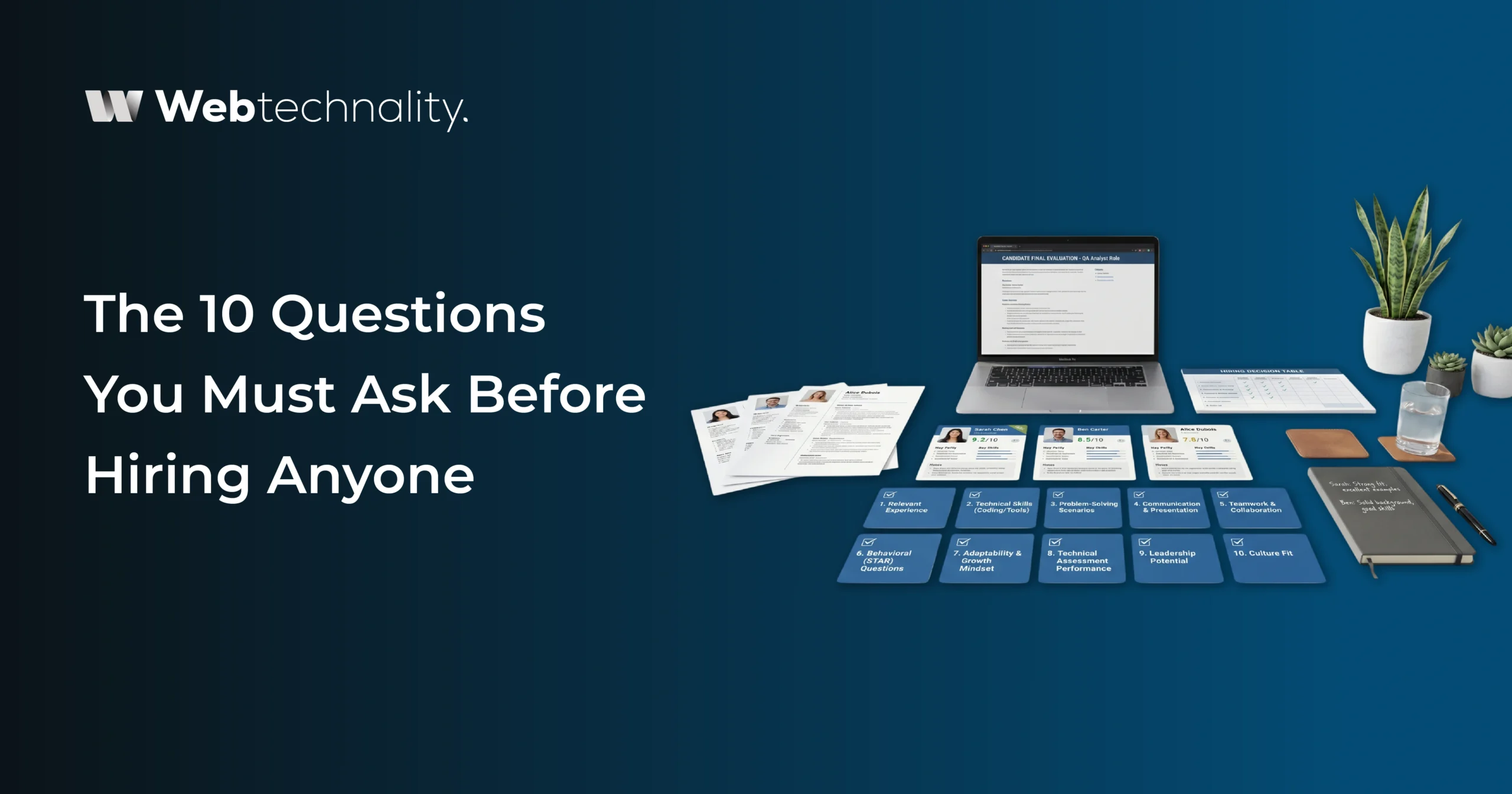
The 10 Questions You Must Ask Before Hiring Anyone
These are the questions that separate professional agencies with mature processes from operations that will frustrate you and underdeliver. Ask every one of them before signing anything.
- “Who specifically will be working on my project?” — You need to know if your site is being built by the experienced person you met in the sales call or being handed to a junior contractor overseas.
- “Can I see three live websites you have built in the last 12 months?” — Recent work matters. Technology and design standards evolve fast, and a portfolio full of older builds may not reflect current capabilities.
- “Will I own 100% of the website, files, hosting account, and domain when we are done?” — Some agencies retain ownership as a dependency mechanism. Full ownership is non-negotiable.
- “What is your revision process, and how many rounds are included in the quoted price?” — This tells you how conflicts over direction will be handled and whether the scope is genuinely defined.
- “How do you handle SEO during the build?” — The right answer includes page structure planning, meta tag setup, image optimization, schema markup, and Search Console submission.
- “What platform will you build on, and why?” — The platform choice should be justified based on your needs, not simply what the agency always uses.
- “What happens if I need changes after launch?” — Post-launch support and pricing should be clearly defined before signing the contract.
- “Can I speak with a client in a similar industry to mine?” — Industry-specific experience matters. Relevant case studies reduce risk.
- “How do you measure success on a website project?” — If the answer is only design approval, that is a design shop. If the answer includes traffic, conversions, and lead tracking, that is a growth partner.
- “What does your typical project timeline look like, and what causes delays?” — Honest agencies will explain common delays and how they manage them.
Understand the Different Types of Web Design Companies
Not all web design companies are the same kind of business. Understanding the categories helps you match the right provider to your actual needs and budget.
| Type | What They Do Best | Typical Cost Range | Watch Out For |
|---|---|---|---|
| Solo Freelancer | Simple sites, tight budgets, fast turnaround | $1,000 – $3,500 | No backup if they go unavailable; limited scope |
| Design-Only Agency | Visual design, branding, UI/UX | $5,000 – $20,000 | May not include SEO, development, or marketing strategy |
| Development-Focused Agency | Complex builds, custom functionality, integrations | $8,000 – $50,000+ | Design may be secondary; it may lack a marketing strategy |
| Full-Service Digital Agency | Design + development + SEO + marketing in one | $4,000 – $25,000+ | Quality varies; vet marketing capabilities separately |
| Enterprise Web Agency | Large-scale platforms, enterprise integrations, teams | $30,000 – $250,000+ | Overkill for most SMBs; minimum engagement thresholds |
For most small and mid-sized businesses, a full-service digital agency in the $4,000–$15,000 range delivers the best combination of design quality, SEO integration, and ongoing support capacity. Webtechnality sits squarely in this category. We design, build, optimize, and market websites as a single integrated service.
Not Sure Which Type of Agency You Need?
Tell us about your business and what you need your website to accomplish. We will give you an honest recommendation — even if that means pointing you toward a different solution. No sales pressure, just straight advice.
Talk to Webtechnality FreeHow to Compare Proposals Without Getting Confused
When you have three proposals in front of you with different prices and different scopes, comparing them fairly requires a structured approach. A $3,000 proposal and a $7,000 proposal may actually be covering very different scopes or the same scope at different quality levels. You cannot tell until you look closely.
📋 Build a Comparison Checklist
For every proposal you receive, confirm whether each of the following is explicitly included or explicitly excluded:
- Number of pages included in the base price
- Custom design vs template customization
- Mobile responsive design (should always be included)
- SEO setup: meta tags, page titles, sitemap, robots.txt
- Schema markup implementation
- Google Analytics and Search Console setup and verification
- Page speed optimization
- SSL certificate setup
- Contact form and lead capture setup
- Number of design revision rounds
- Post-launch support period and pricing
- Content writing (copywriting) — included or separate cost?
- Domain and hosting setup — included, separate, or client-managed?
- Training on how to update the site after launch
Items not mentioned in a proposal are almost always additional costs later. When you surface these gaps with each agency, you will quickly discover which ones have genuinely comprehensive scopes and which ones are lowballing to win the deal.
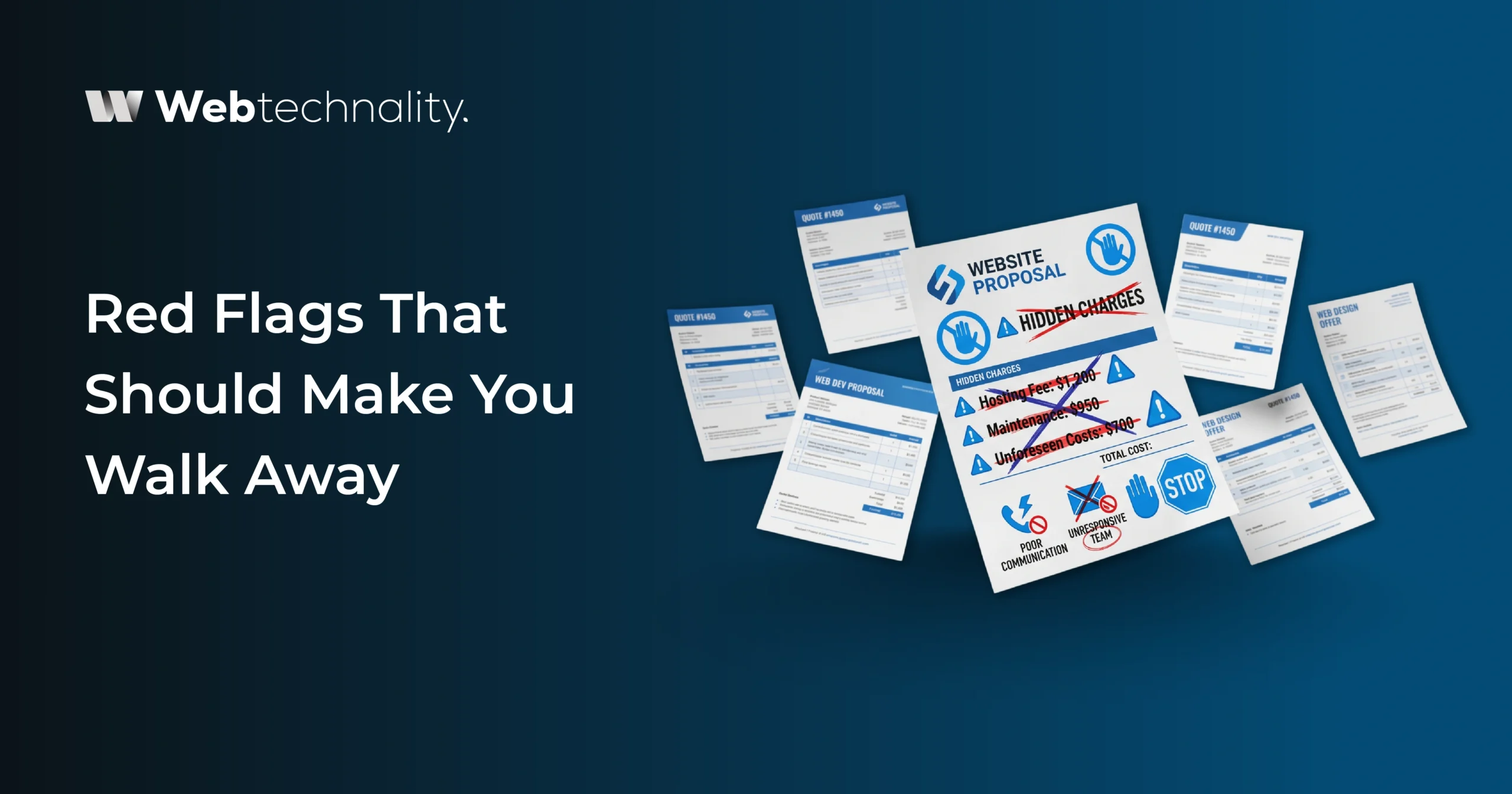
Red Flags That Should Make You Walk Away
Some signals in an agency’s behavior, communication, or proposal should be treated as genuine warning signs, not minor annoyances to overlook.
- They cannot show you live website URLs — Mockups and screenshots are not portfolio evidence. If you cannot visit the actual website and test it yourself, the portfolio is unverifiable.
- They make SEO promises they cannot back up — “We will get you to page one of Google in 30 days” is either a lie or a reference to black-hat tactics that will get your site penalized. No legitimate agency makes specific ranking guarantees.
- They avoid the ownership question — If an agency deflects, qualifies, or becomes defensive when you ask about full website ownership, that is a major red flag.
- They push you toward a proprietary platform you cannot leave — Some agencies build on platforms that only they can edit or maintain, creating permanent dependency. Insist on widely supported platforms like WordPress, Webflow, or Shopify.
- Communication is slow or evasive before you even sign — If they are slow to respond during the sales process when they are trying to win your business, imagine how responsive they will be six months into your project when an issue arises.
- They cannot explain their process — A professional agency has a defined workflow: discovery, strategy, wireframes, design, development, QA, launch. If they cannot walk you through their process clearly, they do not have one.

Green Flags You Want to See in a Great Agency
Just as important as knowing what to avoid is recognizing genuine signs of a trustworthy, capable partner.
- They ask more questions about your business goals than your aesthetic preferences — because they understand that good design serves business objectives.
- They proactively explain what they will not be able to do or what is outside their wheelhouse — honesty about limitations is a sign of maturity.
- Their proposals are itemized, with clear definitions of what is and is not included.
- They have a defined process they can walk you through step by step, from kick-off to launch.
- Their references consistently mention communication quality alongside technical quality.
- They discuss SEO, conversion, and traffic goals as part of the design brief — not as an add-on afterthought.
- They set realistic timelines and explain clearly what causes projects to run long.
- They have a post-launch support plan that is explicit and reasonably priced.
In a survey of 500 small business owners who had invested in website redesigns, the top two regrets were: (1) not asking enough questions before signing the contract, and (2) choosing on price alone rather than evaluating communication quality and post-launch support. The lowest-cost option was consistently associated with the most regret.
Frequently Asked Questions
What should I look for when choosing a website design company?
Look for a portfolio with results, not just aesthetics. Ask specifically about previous clients’ traffic, leads, and conversion improvements after a redesign. A design company that cannot speak to business outcomes is a design-only shop, and design alone does not drive growth.
How many web design proposals should I request before deciding?
Request at least three proposals from agencies at different price points. Comparing proposals from a solo freelancer, a mid-size agency, and a larger firm helps you understand the market, clarify your needs, and evaluate what is genuinely included in each quote versus what costs extra.
How do I know if a web design agency is legitimate?
Legitimate agencies have verifiable client references, a physical address or identifiable team, a clear contract process, and a portfolio of live websites you can actually visit and test. Check Google reviews, Clutch, and LinkedIn for independent verification. Be cautious of agencies that show only mockup images rather than live URLs.
Should I hire a local web design company, or is remote fine?
Remote agencies are entirely viable in 2026 and often deliver excellent results. Local agencies offer the benefit of in-person meetings and regional market knowledge, which can be valuable for local service businesses. The quality of their work and communication process matters far more than physical proximity.
What is the difference between a web design company and a full-service digital agency?
A web design company focuses primarily on visual design and front-end development. A full-service digital agency like Webtechnality provides web design alongside SEO, content strategy, paid advertising, and ongoing marketing, ensuring the website is built to generate traffic and leads, not just to look professional.
What questions should I ask a web design company before hiring them?
Ask: Who specifically will be working on my project? Do I own everything when we’re done? What does your revision process look like? How do you handle SEO during the build? Can I speak with three recent clients? What happens if I need changes after launch? These questions quickly separate professional agencies from inexperienced vendors.
How does Webtechnality approach website design differently?
Web Technality designs websites as business growth tools, not just digital brochures. Every project includes conversion-focused design, on-page SEO, analytics setup, and a post-launch support plan. We measure success by leads and traffic growth, not just client approval of how it looks.
Making Your Final Decision
Choosing a website design company is not just a purchasing decision it is a partnership decision. The agency you choose will have a significant influence over one of your most important business assets for years to come. The process deserves more than thirty minutes of Googling and accepting the first quote that seems reasonable.
When you use the framework in this guide, defining your goals first, evaluating portfolios on performance rather than visuals, asking the right questions, comparing proposals on equal terms, and taking red and green flags seriously, you drastically increase your probability of finding a partner who delivers genuine business value rather than just a pretty website.
Your Decision Checklist:
- Written goal statement: What does your website need to accomplish for your business specifically?
- Three proposals minimum: At different price points and agency types for real comparison
- Portfolio live URL review: Open and test actual websites’ speed, mobile, CTAs, and clarity
- Client references called: Speak with real clients and ask the hard questions
- 10 pre-hire questions answered: Document the answers and compare across candidates
- Ownership confirmed in writing: Before you sign, not after
- Post-launch support defined: Cost and scope of maintenance clearly documented in the contract
Ready to Work with an Agency That Measures Success in Leads, Not Likes?
Webtechnality has helped hundreds of small and mid-sized businesses across the USA build websites that generate real business results. Schedule a free consultation to tell us about your goals we will tell you exactly what we can deliver and what it will cost, with zero vague language.
Schedule Your Free ConsultationAbout Webtechnality
Webtechnality is a full-service digital agency based in Kingman, Arizona, specializing in web design, SEO, AI development, and digital marketing. With 10+ years of experience and 5,000+ projects delivered, we help small and mid-sized businesses build online presences that generate real leads and sustainable growth.