Not long ago, the goal of every SEO strategy was simple: rank on page one of Google. Get into the top three results for your target keywords, and the traffic will follow. That model made sense when search was a list of links that users evaluated and clicked through to reach you.
But that is not how most people search anymore. In 2026, a growing proportion of search queries are answered directly by AI-synthesized responses generated by tools like Google AI Overviews, Perplexity, and ChatGPT Search. The user asks a question. The AI answers it. And the businesses that get cited in those answers get the attention, the trust, and often the click.
This shift has created a new discipline: Generative Engine Optimization, or GEO. It is not a replacement for traditional SEO. It is the next layer on top of it, the set of strategies that determine whether AI search engines choose to cite your content or pass it over in favor of a competitor who has optimized more deliberately for this new audience.
At Web Technality, we have been building GEO-ready content strategies for clients since AI Overviews first became mainstream. This guide shares everything we know about how it works and what it takes to win visibility in the AI search era.
According to BrightEdge’s 2026 AI Search Index, Google AI Overviews now appear on 58% of all search queries. Perplexity processes over 100 million queries per month. ChatGPT Search has over 600 million active users. The audience for AI-generated answers is no longer niche — it is the mainstream.
What is Generative Engine Optimization (GEO)?
Generative Engine Optimization is the practice of optimizing your website content, digital authority, and online presence so that AI-powered search engines choose to cite your business or content when generating answers to user queries.
The term was coined by researchers at Princeton, Georgia Tech, and the Allen Institute for AI in a 2023 paper that studied how LLM-based search engines selected content for inclusion in their responses. The core finding was that certain content attributes, such as factual density, citation of authoritative sources, structural clarity, and domain specificity, significantly increased the likelihood of a piece of content being included in AI-generated answers.
In practical terms, GEO means writing content that a language model can confidently use as a source. It means being the answer that AI trusts to give to its users. And in an era where being cited by an AI is increasingly how businesses get discovered, that trust is worth more than a page-two ranking ever was.
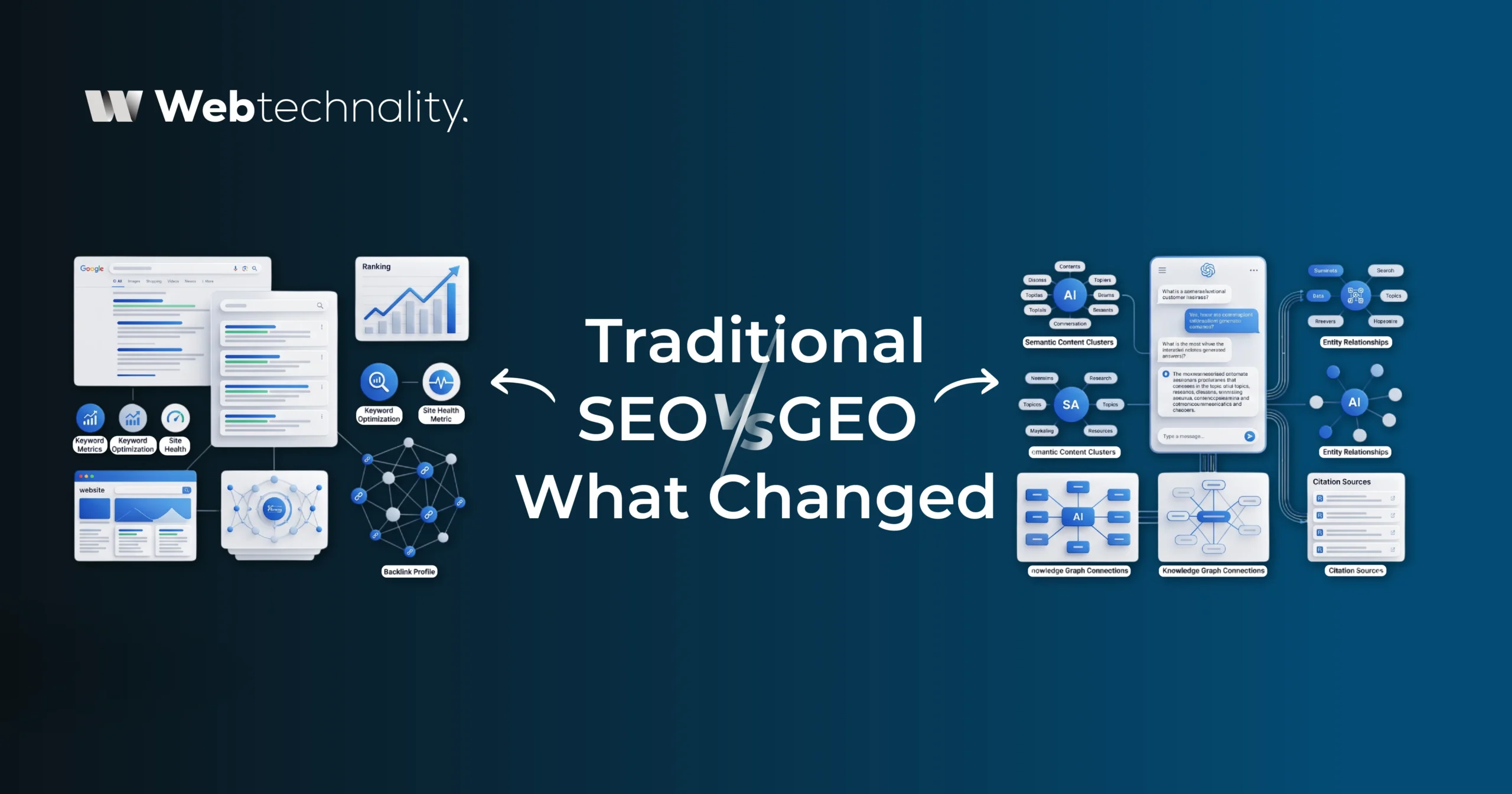
Traditional SEO vs GEO: What Changed
| Dimension | Traditional SEO | Generative Engine Optimization (GEO) |
|---|---|---|
| Target audience | Search ranking algorithm | Large language model reasoning system |
| Success metric | Ranking position in SERP | Citation frequency in AI-generated answers |
| Content goal | Keyword relevance and backlink authority | Factual accuracy, specificity, and trustworthiness |
| Format preference | Long-form keyword-rich articles | Structured, direct-answer content with clear headings |
| Trust signals | Domain authority and backlink profile | E-E-A-T, citations, first-hand expertise, real data |
| Schema markup | Helpful for rich snippets | Essential for AI content comprehension |
| Update frequency | Fresh content rewards | Accuracy and relevance outweigh recency alone |
| Competitive advantage | More backlinks, better technical health | Deeper expertise, more specific answers |
The fundamental insight is this: traditional SEO was about being findable. GEO is about being citable. The audience has changed from an algorithm to a reasoning model, and the optimization target has changed accordingly.
How AI Search Engines Decide What to Cite
Understanding the citation decision process is the foundation of any effective GEO strategy. AI search engines do not rank pages as Google does. They evaluate them on a different set of criteria before deciding whether to include them in a generated response.
Based on current research and our own observation of citation patterns across platforms, these are the primary factors that determine whether an AI system cites your content:
- Factual specificity: Content that makes specific, verifiable claims with attributed data is far more likely to be cited than content making general assertions. “Studies show that conversion rates improve” is weak. “A 2026 HubSpot study found that companies with AI lead scoring see a 28% higher close rate” is citable.
- Structural clarity: AI systems navigate your content through your heading structure. Clear H2s and H3s that directly describe the topic of each section make your content significantly more extractable and citable than narrative prose without structural signposting.
- Domain authority signals: AI search engines are trained on the indexed web. Pages with strong backlink profiles from relevant, authoritative sources are treated as more trustworthy references for generated answers.
- First-hand expertise: Language models can distinguish between generic secondary content and content written from direct experience. Case studies, original data, first-person professional observations, and client outcomes signal the kind of expertise that AI systems prefer to cite.
- Answer-first format: Content that leads each section with a direct answer to the implied question before expanding into context and detail is structured in exactly the way AI systems extract information for generated responses.
- Schema markup completeness: Complete and accurate structured data gives AI systems explicit information about your content’s meaning, reducing the ambiguity that can cause a page to be overlooked in favor of a more clearly labeled alternative.
The Major AI Search Platforms and Their Behaviors
GEO is not a one-size-fits-all strategy. Each major AI search platform has distinct behaviors and citation tendencies worth understanding.
Google AI Overviews
Google’s AI Overviews appear at the top of search results for a wide range of queries and synthesize answers primarily from pages already indexed and ranking in Google’s traditional results. Strong traditional SEO remains the foundation for Google AI Overview inclusion. Pages that already rank on page one for their target keyword are significantly more likely to be cited in the corresponding AI Overview. Schema markup, E-E-A-T signals, and structured FAQ content are particularly influential.
Perplexity AI
Perplexity is a citation-heavy platform that typically shows 3 to 5 source links alongside its generated answers. It favors content that is highly specific to the query, factually dense, and from domains with relevant topical authority. Perplexity is more willing to cite niche expert sources than Google, which creates a significant opportunity for specialized businesses and professional service firms whose depth of expertise on a narrow topic exceeds that of large general publishers.
ChatGPT Search
ChatGPT Search integrates web browsing to supplement its responses with current data. It tends to favor recent, authoritative sources and is particularly strong at finding and citing structured content like comparison guides, how-to articles, and data-backed analyses. Building consistent, regularly updated content around your core topics improves citation frequency in ChatGPT Search over time.
Microsoft Copilot
Microsoft Copilot uses Bing’s index as its primary source and applies similar citation criteria to Perplexity. Strong Bing SEO performance correlates directly with Copilot citation frequency. Businesses that have neglected Bing optimization in favor of Google-only strategies should audit their Bing presence as part of a comprehensive GEO effort.

The 8 Pillars of Effective GEO Strategy
Build Topical Authority, Not Just Individual Posts
AI search engines evaluate the depth of your coverage of a topic, not just the quality of a single page. Publishing a cluster of interconnected, comprehensive content around your core topic areas a pillar page supported by multiple related posts that link to and from it signals domain expertise far more effectively than isolated blog posts. A business that has published 15 high-quality interconnected pieces on “B2B ecommerce automation” is cited far more frequently than one that published a single comprehensive guide on the same topic.
Lead Every Section With a Direct Answer
Restructure your content so that every heading is followed immediately by a clear, complete answer to the question the heading implies before any elaboration or context. This mirrors the way AI systems extract content for generated answers. If the direct answer is buried in the third paragraph of a section, many AI systems will not find it. If it is the first sentence, it becomes immediately extractable and citable.
Add Specific Data and Cited Statistics
Replace every vague claim in your content with a specific, attributed statistic. “Many businesses see improved results” becomes “According to a 2026 Salesforce study, businesses using AI lead scoring see a 28% higher revenue per sales rep.” The specificity signals factual reliability. The attribution signals that you are engaging with real research rather than generating generic assertions. Both are strong GEO trust signals.
Create Genuinely Original Content From Experience
Publish content that could only come from your organization — original client case studies with specific results, proprietary data from your own operations, first-hand professional observations from real project experience, and expert opinions that reflect genuine domain expertise. This type of content is both rarer and more authoritative than curated or secondary content, and AI systems have a strong preference for citing it when it exists and is discoverable.
Implement Complete Schema Markup Across All Pages
Restructure your content so that every heading is followed immediately by a clear, complete answer to the question the heading implies before any elaboration or context. This mirrors the way AI systems extract content for generated answers. If the direct answer is buried in the third paragraph of a section, many AI systems will not find it. If it is the first sentence, it becomes immediately extractable and citable.
Build a Strategic FAQ Presence Across Your Site
FAQ sections are one of the most citable content formats in AI search. They are structured as questions and direct answers — exactly the format AI systems extract for generated responses. Add a robust FAQ section with FAQPage schema to every core service page, every product page, and every high-traffic blog post. Focus on the exact questions your target customers ask at each stage of their decision journey.
Earn Authoritative Backlinks From Relevant Sources
AI search engines that reference the indexed web which includes Google, Perplexity, and ChatGPT Search use backlink authority as a trust proxy when deciding which sources to cite. A business that has earned backlinks from industry publications, local news sources, professional associations, and authoritative directories starts with a significant citation advantage over a business with thin or no off-site authority. GEO authority building and traditional link building are the same activity.
Monitor Your AI Search Visibility and Iterate
GEO is not a one-time optimization. Track when and how your brand appears in AI-generated answers using tools like BrightEdge, Semrush’s AI tracking features, and manual spot-checks across platforms. Identify which content is being cited most frequently, what queries are triggering those citations, and where competitors are appearing instead of you. Use this data to prioritize your next content investments and schema updates.
Ready to Get Your Business Found in AI Search?
Webtechnality builds GEO-optimized content strategies and schema implementations that get your brand cited across Google AI Overviews, Perplexity, and ChatGPT Search. Get a free AI visibility audit today.
Get Your Free GEO AuditContent Formats AI Search Engines, Love
Not all content is equally citable. These are the specific formats that consistently achieve the highest citation rates across AI search platforms in 2026:
- Comprehensive how-to guides with numbered steps and clear outcomes at each stage
- Data-backed comparison articles that evaluate multiple options against specific criteria
- FAQ pages and sections with specific, direct answers formatted for extraction
- Original research and surveys with findings your organization generated directly
- Case studies with measurable outcomes that demonstrate first-hand experience and real results
- Definition and explainer articles on terms within your industry that users are actively searching
- Expert roundups and professional opinions that aggregate named expertise with proper attribution
- Checklists and framework articles that structure complex knowledge into organized, extractable formats
A 2026 Semrush analysis of AI Overview citation patterns found that FAQ-structured content is 3.1x more likely to be cited than equivalent information in narrative paragraph format. How-to guides with numbered steps are 2.4x more likely to be cited than unnumbered prose covering the same instructions.
Frequently Asked Questions
What is Generative Engine Optimization (GEO)?
GEO is the practice of optimizing your website content and digital presence to be cited and surfaced by AI-powered search engines such as Google AI Overviews, Perplexity, and ChatGPT Search. Unlike traditional SEO, which targets ranking positions in link-based results, GEO targets inclusion in AI-generated answers.
How is GEO different from traditional SEO?
Traditional SEO optimizes for ranking positions in a list of links. GEO optimizes for citation in a synthesized AI-generated answer. The audience has changed: instead of a search algorithm ranking your page, a language model is deciding whether your content is authoritative and specific enough to reference when generating a response.
Which AI search engines does GEO target?
GEO primarily targets Google AI Overviews, Perplexity AI, ChatGPT Search, Microsoft Copilot search, and Meta AI search integrations. Each platform has slightly different citation behaviors, but the core GEO strategies around authority, structure, and factual specificity apply across all of them.
Does GEO replace traditional SEO?
No. GEO builds on top of traditional SEO rather than replacing it. Technical health, backlinks, and quality content remain foundational. GEO adds an optimization layer specifically targeting AI citation eligibility. Businesses that do both consistently outperform those doing either alone.
How long does it take to see results from GEO?
GEO results typically appear faster than traditional SEO. Well-structured, authoritative content that implements GEO best practices can appear in AI-generated answers within 2 to 8 weeks of publication or optimization. Citation frequency increases as content accumulates backlinks and engagement signals.
What type of content performs best in GEO?
Content that performs best in GEO is factual, specific, well-structured with clear headings, written from genuine expertise or first-hand experience, cites data with sources, and directly answers questions users are asking. FAQ sections, how-to guides, comparison articles, and data-backed analyses are the formats AI search engines cite most frequently.
Can Webtechnality help with the GEO strategy?
Yes. Webtechnality provides GEO services, including content audits and restructuring for AI citation, schema markup implementation, authority-building strategy, and ongoing visibility monitoring across AI search platforms. We tailor the strategy to your specific industry and target audience.
The Bottom Line
GEO is not a trend to watch. It is a shift already underway that is changing where businesses get discovered, how customers form opinions before they ever visit a website, and which companies earn trust at the moment of a search.
The businesses that get cited in AI-generated answers in 2026 will enjoy a brand visibility advantage that compounds over time. The ones that continue optimizing exclusively for traditional blue-link rankings will find themselves invisible in an increasing share of relevant searches.
The good news is that the core of GEO is the same as the core of great content: be specific, be authoritative, be genuinely useful, and make it easy for any system, human, or AI to understand what you know and who you help.
Start Your GEO Strategy Today:
- Audit your top 10 pages for direct-answer structure and factual specificity
- Add or expand FAQ sections on every core service and product page
- Replace vague claims with attributed statistics throughout your content
- Implement full schema markup across your site if it is not already complete
- Identify your topical gaps and build a content cluster strategy around your primary service areas
Get Your Brand Cited in AI Search
Webtechnality builds GEO strategies that get your business found in Google AI Overviews, Perplexity, and ChatGPT Search. Schedule a free consultation and get a custom GEO roadmap for your industry.
Schedule Your Free GEO ConsultationAbout Webtechnality
Webtechnality is a full-service digital agency in Kingman, Arizona, specializing in SEO, GEO, AI development, web design, and digital marketing. With 10+ years of experience and 5,000+ projects delivered, we help businesses stay visible and competitive as the search landscape evolves.