In recent years, Artificial Intelligence (AI) has revolutionized multiple industries, from healthcare to finance, and even e-commerce. As businesses and developers increasingly focus on incorporating AI into their operations, understanding the detailed process of AI development becomes crucial. Whether you are a beginner or an experienced developer, this guide from Web Technality will walk you through the essential steps of AI development and how to implement it successfully.
What is AI Development?
AI development refers to creating intelligent systems capable of performing tasks that typically require human intelligence, such as understanding natural language, recognizing images, and making decisions. AI systems use machine learning algorithms, neural networks, and other advanced techniques to learn from data and improve over time.
Why is AI Development Important?
AI development can transform how businesses function. It enhances decision-making, automates repetitive tasks, improves customer experiences, and offers personalized solutions. From a web development perspective, AI integration can optimize search engines, content recommendation systems, and chatbots.
At Web Technality, we understand the importance of staying ahead of the curve in AI development. Our team is dedicated to helping businesses integrate AI into their digital strategies effectively.
Detailed Steps of AI Development
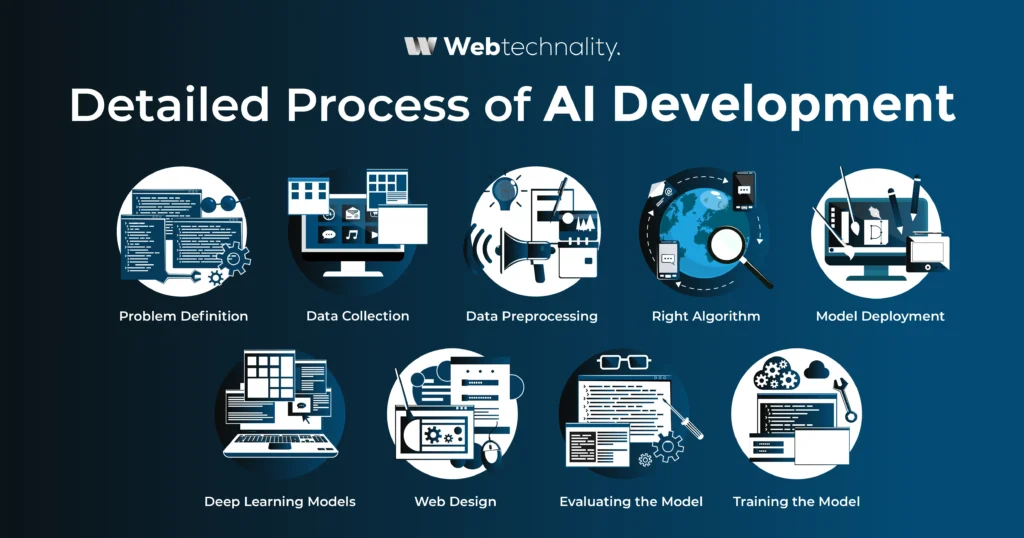
AI development involves several phases, from identifying the problem to deploying and maintaining the model. Let’s break down each stage:
1. Problem Definition
The first step in AI development is defining the problem you’re solving. Whether you aim to build a model for image recognition, customer service, or fraud detection, clear problem definition is crucial.
Key points to consider:
- What is the primary objective of the AI system?
- What type of data will the AI model analyze?
- What are the performance expectations (accuracy, speed, etc.)?
Web Technality emphasizes the importance of defining the problem upfront to align the development process with your business goals.
2. Data Collection and Preparation
Data is the backbone of AI models. The next step is gathering and preparing data for training. Without high-quality, relevant data, your AI model may not perform effectively.
Key tasks:
- Data Collection: Gather structured or unstructured data, including images, text, or numerical data.
- Data Cleaning: Remove irrelevant or incorrect data, handle missing values, and correct inconsistencies to ensure quality.
- Data Labeling: If supervised learning is involved, labeling the data with correct outcomes is essential.
The Web Technality team ensures that the data collected is optimized for building a robust AI model.
3. Data Preprocessing
Once the data is collected, it needs to be preprocessed for AI training. This involves transforming raw data into a format that machine learning algorithms can use.
Common preprocessing steps:
- Normalization: Adjust data values to a consistent scale.
- Feature Selection: Choose the most relevant features or attributes of the data.
- Data Augmentation: Increase data diversity by applying transformations.
This crucial step ensures that your model can learn from the data effectively.
4. Choosing the Right Algorithm
Selecting the right AI algorithm depends on the problem you’re solving. AI algorithms can be supervised, unsupervised, or reinforcement learning-based. The right choice determines how well the model learns from the data.
Popular AI algorithms include:
- Linear Regression
- Decision Trees
- Support Vector Machines (SVM)
- Neural Networks
- Deep Learning Models
Each algorithm has its strengths and is suited for different tasks. For instance, neural networks excel in image and speech recognition, while decision trees are effective for classification.
5. Training the Model
Training the AI model is where the algorithm learns from the data. This step involves adjusting the model’s parameters to minimize errors and improve its performance.
Important considerations during training:
- Training Set vs. Test Set: Divide the data into training and test sets. Use the training set to train the model, and the test set to evaluate performance.
- Overfitting and Underfitting: Make sure the model neither overfits (learning noise) nor underfits (missing patterns).
- Hyperparameter Tuning: Fine-tune settings that control the model’s learning process.
Web Technality helps ensure that your model is trained for optimal performance.
6. Evaluating the Model
After training, the model needs to be evaluated. Test it on new data and measure its performance using metrics such as accuracy, precision, recall, and F1-score.
Key evaluation metrics include:
- Accuracy: The percentage of correct predictions made by the model.
- Precision and Recall: Measures how well the model identifies positive instances and avoids false positives.
- F1-Score: A balance between precision and recall.
The evaluation helps identify areas for improvement, ensuring the model meets performance standards.
7. Model Deployment
Once the model has been trained and evaluated, it’s time for deployment. Integrate the model with existing systems, ensuring it works efficiently in a production environment.
Deployment considerations:
- Scalability: Ensure the model can handle large amounts of data.
- Real-time Processing: The model may need to process data in real time.
- Integration: Make sure the model integrates seamlessly with web or mobile applications.
Web Technality provides seamless AI model integration, ensuring it functions flawlessly in your system.
8. Continuous Monitoring and Maintenance
AI models require ongoing monitoring and updates to ensure they stay accurate over time.
Key monitoring tasks:
- Model Drift: Regularly check if the model’s performance decreases over time.
- Retraining: Update the model with fresh data to maintain its effectiveness.
- User Feedback: Collect feedback from users to identify areas for improvement.
Web Technality helps businesses track and optimize their AI models for sustained success.
Conclusion
AI development is a detailed process involving problem definition, data collection, model training, deployment, and continuous monitoring. By following these steps, developers can create intelligent systems that are efficient, scalable, and adaptable to changing needs.
At Web Technality, we stay on the cutting edge of AI technology, helping businesses build AI-powered solutions that drive success.