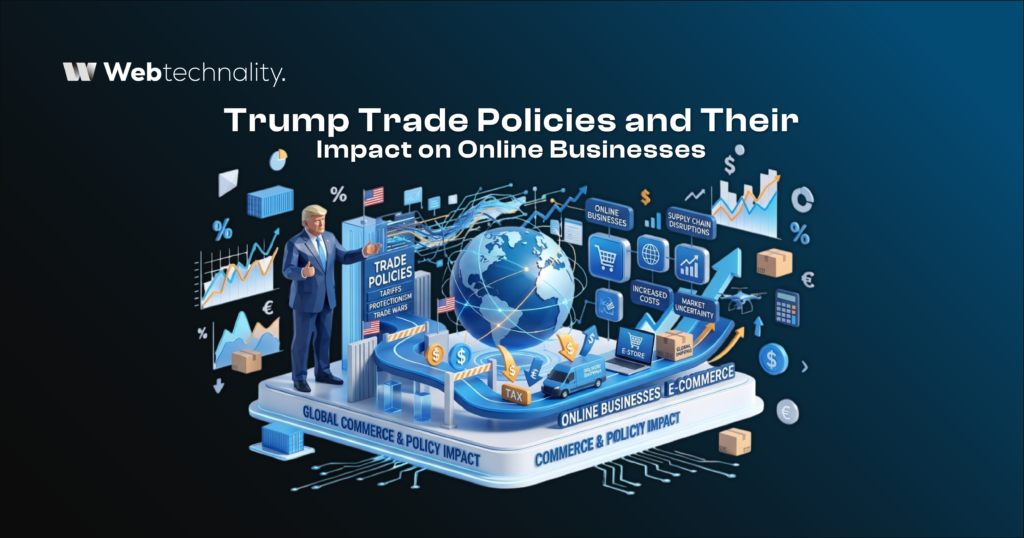
The global business environment has experienced transformative changes over the last few years, and much of that has been shaped by Donald Trump’s administration and its approach to trade. With his aggressive stance on tariffs, renegotiating trade agreements, and enforcing protectionist policies, the trade landscape has become more complex for online businesses, especially those operating across borders. Trump’s trade policies brought both opportunities and challenges for companies, with some sectors thriving under his regime, while others faced disruptions, particularly those that depend heavily on global supply chains, cross-border e-commerce, and international marketing.
In this article, Web Technality will explore how Trump’s trade policies have impacted online businesses and e-commerce companies. More importantly, we will provide actionable strategies for companies to stay competitive, adjust to new challenges, and continue to thrive despite the trade disruptions caused by tariffs, supply chain issues, and regulatory changes.
How Trump’s Trade Policies Affected Online Businesses
Trump’s trade policies had profound implications for online businesses, especially those involved in global sourcing, international marketing, and digital sales. Here are the key effects:
| Impact Area | Effect on Online Businesses |
| Increased Tariffs | Online businesses faced higher costs for importing goods, leading to price increases for consumers. Companies had to adapt by sourcing from other countries or absorbing costs. |
| Supply Chain Disruption | Changes in tariff policies disrupted global supply chains, causing delays in product availability and increased shipping costs, which impacted delivery times for online retailers. |
| E-commerce Regulations | The renegotiation of NAFTA and other trade agreements brought stricter e-commerce regulations, especially for businesses selling across borders. |
| Market Uncertainty | The unpredictability of tariffs and trade policies created an atmosphere of uncertainty, making it difficult for online businesses to forecast long-term growth and expansion. |
| Shifts in Consumer Spending | Higher tariffs on consumer goods led to increased prices, affecting demand and buying behavior among U.S. consumers. Online businesses had to adjust marketing strategies. |
Trump’s Key Trade Policies: A Recap
To truly understand the impact of Trump’s trade policies, let’s first break down some of the most significant aspects of his approach to global trade:
1. Imposition of Tariffs on Chinese Imports
Perhaps one of the most publicized moves was Trump’s decision to impose tariffs on Chinese imports. The goal was to reduce the U.S. trade deficit and force China into trade concessions. Trump’s administration imposed tariffs on hundreds of billions of dollars’ worth of Chinese goods, affecting everything from electronics and clothing to raw materials used by manufacturing companies and online retailers.
Impact on Online Businesses:
- Increased product costs for online retailers who import goods from China.
- Price hikes led to consumers paying more for goods like electronics, clothing, and accessories.
- E-commerce platforms had to raise prices, cutting into profit margins, or absorb the additional costs.
2. Renegotiation of NAFTA into USMCA (United States-Mexico-Canada Agreement)
Trump renegotiated NAFTA to the United States-Mexico-Canada Agreement (USMCA), with the aim of better protecting American workers and industries. This new agreement included tighter regulations on cross-border e-commerce, particularly focusing on digital trade and data privacy.
Impact on Online Businesses:
- While the agreement sought to protect U.S. businesses, it introduced new rules and requirements for e-commerce operations across North America.
- Companies had to adapt to changing regulations on digital services, cross-border data flow, and intellectual property rights.
3. America First and Protectionist Policies
Trump’s protectionist stance aimed to prioritize American companies over foreign competitors. This was evident in trade wars with countries like China, Canada, and the European Union. Trump’s “America First” rhetoric translated into more aggressive tariffs and sanctions against imports to protect U.S. industries.
Impact on Online Businesses:
- Reduced access to foreign goods for U.S.-based online retailers, affecting product availability.
- Online sellers dealing with international suppliers faced higher operational costs due to tariffs.
- The uncertainty led to challenges in pricing, procurement, and supply chain management.
4. Renegotiation of Global Trade Deals
Trump also renegotiated trade deals with other countries, including Japan, South Korea, and the European Union. His administration pushed for more favorable terms for U.S. businesses, which affected multinational corporations and smaller businesses engaged in international e-commerce.
Impact on Online Businesses:
- Online retailers had to adjust to new regulations on international shipping, customs, and import/export restrictions.
- Global businesses faced stricter trade barriers, impacting their ability to source products cheaply from overseas.
Impact on Online Businesses: Detailed Analysis
Trump’s trade policies created a mixed bag of challenges and opportunities for online businesses. Let’s look at the most notable impacts:
1. Increased Tariffs on Imported Goods
What Happened:
The U.S. imposed tariffs on various goods, including electronics, textiles, and raw materials. For online businesses that depend on importing goods, this meant an increase in product costs.
| Impact Area | Effect on Online Businesses |
| Cost of Goods Sold (COGS) | Higher tariffs increased the cost of goods imported from other countries. |
| Price Inflation | Consumers faced higher prices, which resulted in decreased demand for certain products. |
| Profit Margin Shrinkage | Online businesses had to raise prices or absorb the costs, which cut into profit margins. |
What Businesses Can Do Next:
- Diversify Sourcing: Look for alternative suppliers in countries with lower tariffs, such as Southeast Asia or Mexico.
- Reevaluate Pricing Models: Businesses may need to adjust pricing to maintain profitability without alienating customers.
2. Disruption of Global Supply Chains
What Happened:
The U.S.-China trade war and tariffs placed significant pressure on global supply chains. Online businesses that relied on cheap imports, particularly from China, saw delays and increased costs in their supply chains.
| Impact Area | Effect on Online Businesses |
| Shipping Delays | Increased tariffs and disrupted trade routes led to longer shipping times. |
| Inventory Shortages | Manufacturers faced delays, causing stockouts for online retailers. |
| Costly Shipping Routes | Changes in trade routes increased the cost of international shipping. |
What Businesses Can Do Next:
- Strengthen Relationships with Local Manufacturers: To reduce dependency on international shipping, businesses can shift to local suppliers.
- Invest in Predictive Analytics: Using data to forecast demand and optimize inventory management can help businesses avoid stockouts.
3. Shifting Regulatory Landscape
What Happened:
Trade agreements like the USMCA imposed stricter regulations on e-commerce and digital services. This shift impacted online businesses that sold digital goods or engaged in cross-border digital transactions.
| Impact Area | Effect on Online Businesses |
| Compliance Costs | Businesses had to invest in legal resources to comply with new digital trade rules. |
| Cross-Border Restrictions | Increased regulations for cross-border e-commerce meant higher costs for online transactions. |
What Businesses Can Do Next:
- Stay Updated on Regulatory Changes: E-commerce businesses should monitor trade agreements and regulations to ensure compliance.
- Invest in Legal Expertise: Businesses should consult with legal experts to stay compliant with the ever-changing regulatory landscape.
What Companies Must Do Next: Strategic Steps for Online Businesses
Despite the challenges posed by Trump’s trade policies, there are steps online businesses can take to adapt and thrive.
1. Reevaluate Your Global Supply Chain
It’s crucial for online businesses to assess their reliance on international suppliers, particularly in countries affected by tariffs. Consider diversifying your supply chain to minimize risk.
- Shift to local suppliers to avoid import tariffs.
- Build resilience by diversifying production in multiple countries.
2. Optimize Pricing Strategies
Increased operational costs due to tariffs may require businesses to reassess their pricing strategies.
- Increase product prices strategically to cover the higher costs of imports.
- Offer value-added services like free shipping to justify higher product prices.
3. Adapt to Regulatory Changes
The shift in trade regulations requires online businesses to stay compliant with new rules on cross-border digital transactions.
- Invest in compliance tools to help navigate international trade regulations.
- Consult with legal experts to understand how new regulations affect your business operations.
4. Leverage Technology for Supply Chain Management
Automation and AI can help businesses streamline their operations and improve supply chain management.
- Use AI-driven analytics to forecast demand and optimize inventory management.
- Invest in automated tools for smoother order fulfillment and shipping.
Conclusion
Trump’s trade policies have had a significant impact on online businesses, introducing both challenges and opportunities. While tariffs and disruptions to global supply chains have created obstacles, businesses that adapt quickly to the evolving trade landscape can thrive. By diversifying sourcing, adjusting pricing models, and staying compliant with new regulations, companies can navigate these turbulent times and continue to build successful online enterprises.
Trump’s Policies Are Impacting Global Businesses
FAQs:
- What are the long-term impacts of Trump’s trade policies on e-commerce?
- Long-term impacts include higher operational costs, stricter trade regulations, and a more complex global supply chain.
- Long-term impacts include higher operational costs, stricter trade regulations, and a more complex global supply chain.
- How can online businesses deal with tariff increases?
- By diversifying suppliers, increasing prices, or absorbing costs through improved operational efficiency.
- By diversifying suppliers, increasing prices, or absorbing costs through improved operational efficiency.
- What industries are most affected by these trade policies?
- E-commerce businesses in electronics, fashion, and raw materials were particularly impacted by the increased tariffs.
- E-commerce businesses in electronics, fashion, and raw materials were particularly impacted by the increased tariffs.
- How can businesses ensure compliance with new regulations?
- By staying informed about trade agreements and consulting with legal experts.
- By staying informed about trade agreements and consulting with legal experts.
- Can online businesses survive amid these trade challenges?
- Yes, with strategic adaptation such as supply chain diversification, technology use, and regulatory compliance, businesses can survive and thrive.