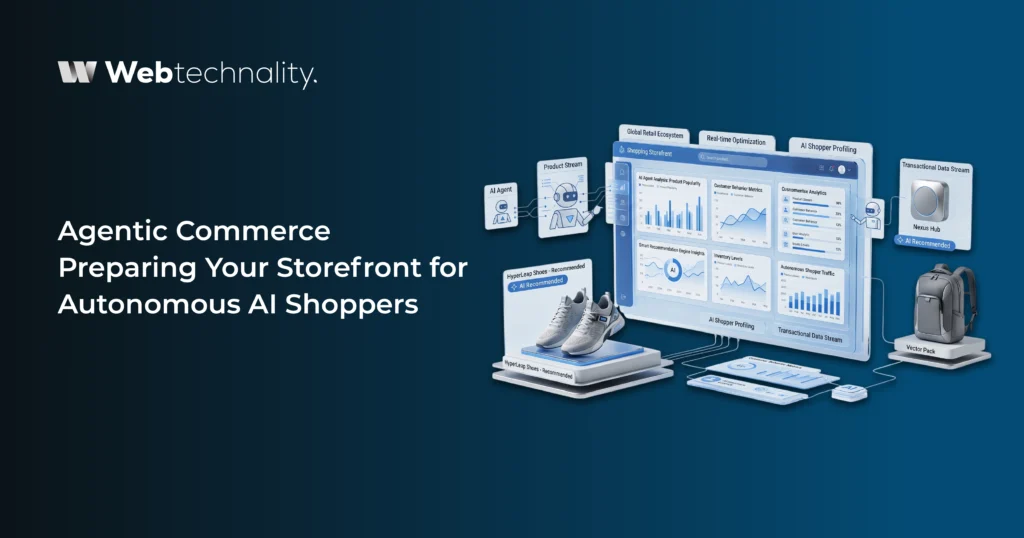
The way people shop online is about to change, and for many businesses, it already has. Not because customers are smarter or more demanding, but because in many cases, it is no longer a human doing the shopping at all.
Welcome to the era of agentic commerce, where AI agents browse product catalogs, compare prices, evaluate reviews, negotiate terms, and complete purchases entirely on their own. No human hands on the keyboard. No eyes on the screen.
This is not science fiction. It is the next major evolution of ecommerce, and the storefronts that survive it will be the ones deliberately built for it. At Webtechnality, we have been helping businesses build smarter digital storefronts for over a decade. And right now, the single biggest question we hear from ecommerce owners is: “Is my store ready for what is coming?”
Tools like OpenAI Operator and Google Gemini-based shopping agents are already browsing stores, comparing products, and completing purchases autonomously in 2026. Businesses that optimize early will capture a structural advantage that compounds over time.
What is Agentic Commerce, Exactly?
Before we talk about preparation, we need to understand what we are actually preparing for.
Agentic commerce refers to the use of AI agents, autonomous software systems powered by large language models (LLMs), to handle shopping tasks on behalf of a user. These agents do not just help people find products. They act independently, making decisions based on user preferences, budgets, and behavioral data.
Think of it this way: a customer sets up their AI assistant and says, “Buy me the best noise-cancelling headphones under $200 with next-day delivery.” The agent then goes off, searches multiple storefronts, reads product descriptions, compares specs, checks reviews, verifies return policies, and places an order, all without the user lifting a finger.
For ecommerce store owners, this raises an uncomfortable but critical question: Is your product data, pricing structure, and checkout flow built to be understood and trusted by an AI, not just a human?
A McKinsey report from early 2026 found that 34% of online shoppers under 35 have already used an AI assistant to help complete a purchase. That number is growing every quarter.
Why Most Storefronts Are Not Ready
Here is a hard truth: most e-commerce websites were designed for human eyes. They rely on visual design cues, emotional marketing copy, and UI patterns that a person navigates intuitively.
AI agents do not work like that. An AI shopping agent reads your product pages the way a machine reads a document. It looks for clean, structured, unambiguous data. If your product titles are vague, your specs are buried in image files, your pricing is unclear, or your structured data markup is missing, the agent may skip your store entirely.
Here are the five most common failure points we see when auditing e-commerce stores:
- Unstructured Product Data: Product attributes like dimensions, materials, compatibility, and weight are not clearly labeled. AI agents cannot extract them reliably and will not guess.
- Missing Schema Markup: Without proper Product, Offer, Review, and BreadcrumbList schema, your storefront is invisible to AI reasoning systems.
- Friction-Heavy Checkout Flows: Unexpected popups, multi-step forms without clear labels, CAPTCHA systems, or sessions that expire mid-process cause AI agents to abandon checkout.
- No API or Programmatic Access: AI agents often interact via APIs rather than browsers. If your store has no machine-readable access point, you are locked out of agent-driven traffic entirely.
- Stale Inventory and Pricing Data: AI agents optimize in real time. Inaccurate pricing or stock status creates failed transactions and destroys trust immediately.
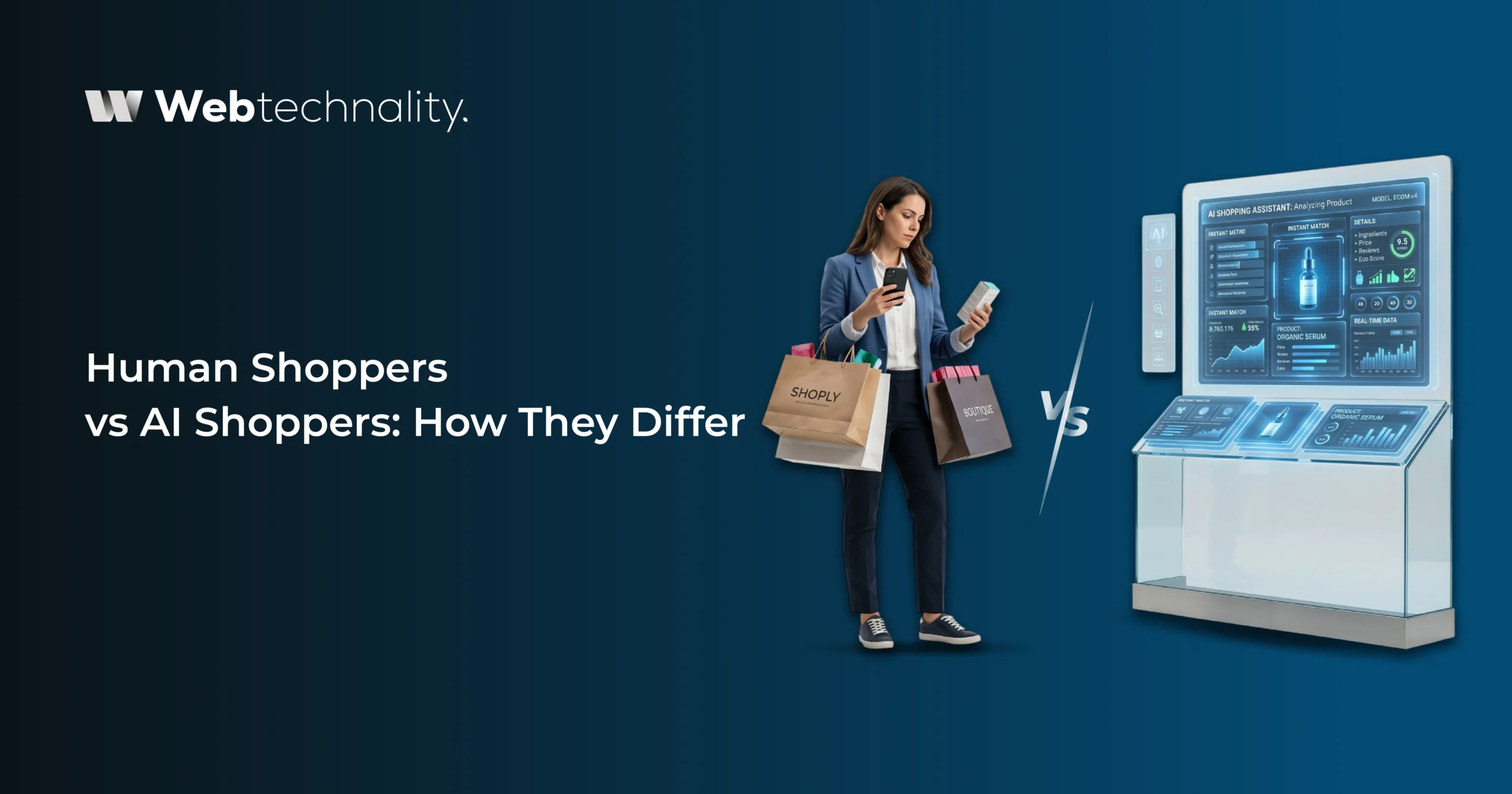
Human Shoppers vs AI Shoppers: How They Differ
Understanding the difference in behavior helps you prioritize your optimization efforts correctly.
| Factor | Human Shopper | AI Shopping Agent |
|---|---|---|
| Navigation | Browses visually, follows design cues | Reads structured data, APIs, and text |
| Decision making | Influenced by visuals and emotion | Based entirely on structured attributes |
| Product discovery | Search, browsing, social media | Schema data, APIs, and semantic content |
| Checkout behavior | Can navigate friction manually | Abandons on any unexpected friction |
| Trust signals | Reviews, brand aesthetics, social proof | Structured review data, policy clarity, schema |
| Speed | Minutes to hours per purchase decision | Seconds to minutes for full purchase cycle |
| Price sensitivity | Varies by emotion and brand loyalty | Always optimizes for best available value |
The takeaway: everything that makes a store great for humans, beautiful imagery, clever copy, and engaging design, is secondary to AI agents. What matters to them is clean data, reliable APIs, and frictionless execution.
7 Steps to Prepare Your Storefront for Autonomous AI Shoppers
So what does a truly AI-ready storefront look like in practice? Here is how we approach it at Web Design Agency when building and optimizing e-commerce platforms for the next generation of shoppers.
1. Implement Full Schema.org Markup
This is non-negotiable. Each product page should include Product schema with name, description, brand, and SKU, Offer schema with price, currency, and availability, AggregateRating schema if you have reviews, FAQPage schema for common product questions, and BreadcrumbList schema to communicate page hierarchy. AI agents parse schema far more deeply than Google crawlers do, so incomplete markup is worse than none at all.
2. Clean and Standardize Your Product Data
Go through your catalog and eliminate vagueness. Replace “medium sized bag” with “38cm x 24cm x 12cm shoulder bag, 900g.” Replace “fast shipping” with “delivery in 2 to 5 business days via FedEx Ground.” Each attributes an AI might use in a comparison should be explicitly labeled. Think like a spreadsheet, not a brochure.
3. Adopt a Headless or API-First Commerce Architecture
This is the long-term architectural move that makes your storefront genuinely agent-accessible. Platforms like Shopify via its Storefront API, Medusa.js, and custom-built solutions allow AI agents to query products, check inventory, and initiate purchases programmatically. Our e-commerce development team at Webtechnality builds with API-first architectures in mind, knowing that the next wave of shoppers will often be software, not humans.
4. Optimize Your Checkout for Non-Human Sessions
Review your checkout flow with one question in mind: can a software agent complete this without breaking? Ensure form fields have explicit machine-readable labels, remove CAPTCHA from steps that can be validated in other ways, support guest checkout with minimal required fields, and use deterministic URL structures without JavaScript-only navigation.
5. Publish a Machine-Readable Store Policy Page
AI agents increasingly check return, refund, and privacy policies before completing a purchase on behalf of users. Structure your policies with clear heading tags and consider adding structured data to make key terms extractable. If your policy is buried in a wall of text or only accessible as a PDF, agents cannot parse it efficiently, and that creates hesitation or abandonment.
6. Build for Semantic Search and Intent, Not Just Keywords
AI agents do not just match keywords. They understand intent. Your product descriptions should answer the why behind a purchase, not just the what. Instead of “Blue running shoes, size 9,” write “Lightweight blue running shoes designed for long-distance road running, offering superior arch support and breathable mesh upper, ideal for daily training or marathon prep.” This semantic richness helps AI agents understand exactly who should buy your product.
7. Integrate Real-Time Inventory and Pricing Feeds
AI agents make real-time decisions. Stale data is worse than no data. It creates failed transactions and lost trust permanently. If your inventory is not synced in real time, implement webhooks or polling mechanisms that keep your public-facing data accurate at all times. This is especially critical for high-velocity SKUs and flash sale pricing.
Start with schema markup and product data cleanup. These two changes alone can significantly improve your store’s visibility to AI shopping agents within weeks, with no architectural overhaul required.

Agentic Commerce and Your SEO Strategy
Here is something most SEO guides have not caught up to yet: AI agents are also changing how organic discovery works.
When a user asks an AI assistant to “find the best waterproof hiking boots under $150,” the agent may query a search engine, read product pages, and synthesize results, often without the human ever visiting your site directly. This is sometimes called zero-click commerce.
To remain visible in this new layer of discovery, your SEO strategy needs to evolve in four key ways:
- Optimize for conversational and question-based queries that reflect how people instruct AI assistants
- Build FAQ sections that directly answer comparative and purchase-intent questions
- Earn high-authority backlinks that signal trustworthiness to both AI agents and search engines
- Focus on E-E-A-T signals (Experience, Expertise, Authoritativeness, Trustworthiness) because AI agents prioritize credible sources
Our SEO services at Webtechnality are built around this next-generation framework, combining technical SEO with AI-readiness audits to ensure your store stays visible regardless of how your customers find you.
The Opportunity, Not Just the Threat
It is easy to read all of this as a warning. But agentic commerce is also an enormous opportunity for businesses that get ahead of it.
Storefronts that are structured, transparent, and machine-readable will be preferred by AI agents. If your competitors are still running stores optimized for 2018 shopping behavior, and yours is ready for 2026 AI-driven commerce, you gain a structural advantage that compounds over time.
Early movers in agentic commerce readiness consistently see higher conversion rates from agent-initiated purchases, better placement in AI-powered discovery layers, fewer abandoned carts caused by data or checkout friction, and greater trust and repeat behavior from AI-assisted customers.
The investment is real. But so is the upside. The next generation of shoppers is not entirely human. The question is not whether to prepare. It is how fast you can do it.
Businesses that invest in structured data and API-first ecommerce architecture today are positioning themselves to capture a significant share of the estimated $1.2 trillion in AI-assisted commerce transactions projected by 2028.
Frequently Asked Questions
What is agentic commerce?
Agentic commerce is the use of autonomous AI agents to carry out shopping tasks, including product research, comparison, and purchase completion on behalf of human users, without direct human involvement in each step. The user sets the goal, and the AI agent executes the entire shopping journey independently.
How do AI agents interact with e-commerce storefronts?
AI agents typically read product pages, structured data, and APIs to extract information about products, pricing, availability, and policies. They may interact through browsers or programmatic API calls depending on the platform they are running on.
Do I need to rebuild my entire website to support AI shoppers?
Not necessarily. Many optimizations, such as adding structured data, improving product descriptions, and streamlining checkout, can be done incrementally without a full rebuild. Starting with schema markup and product data cleanup delivers immediate results without major investment.
Which e-commerce platforms are most AI-agent friendly?
Platforms with robust APIs like Shopify via its Storefront API, Medusa.js, and custom headless commerce solutions are currently best positioned for agentic commerce interactions. Webtechnality builds on all of these platforms, depending on client needs.
How does agentic commerce affect my SEO strategy?
AI agents are changing how organic discovery works. You need to optimize for conversational and question-based queries, build strong FAQ sections, earn high-authority backlinks, and focus on E-E-A-T signals to stay visible in AI-driven search and recommendation systems.
What is schema markup, and why does it matter for AI shoppers?
Schema markup is structured data code that tells machines exactly what your content means. AI shopping agents rely on Product, Offer, Review, and FAQ schema to extract and understand your store data. Without it, agents may not be able to interpret your listings and will move on to a competitor’s store.
When will agentic commerce become mainstream?
It is already happening. Tools like OpenAI Operator and Google Gemini-based shopping agents are actively being used in 2026. Adoption will accelerate rapidly over the next 12 to 24 months, making preparation urgent for any serious e-commerce business.
The Bottom Line
E-commerce stores were built for human shoppers. But in 2026, an increasing share of purchase decisions will be initiated, researched, and completed by autonomous AI agents acting on their users’ behalf.
The storefronts that win in this new reality will not be the ones with the prettiest design. They will be the ones with the cleanest data, the most complete schema markup, the most frictionless checkout, and the most transparent policies.
Your Next Steps:
- Audit your schema markup: Use Google’s Rich Results Test to find gaps in your structured data
- Review your product data: Make every attribute explicit, specific, and machine-readable
- Test your checkout: Walk through it as if you were a software agent, not a human
- Update your policies: Make them structured, clear, and easy to parse
- Talk to an expert: Get a professional AI readiness audit for your specific platform
About Webtechnality
Webtechnality is a full-service digital agency based in Kingman, Arizona, specializing in ecommerce development, AI integration, and SEO services. With 10+ years of experience and 5,000+ projects delivered, we help businesses build digital storefronts and platforms that perform for both human visitors and the next generation of autonomous AI shoppers.