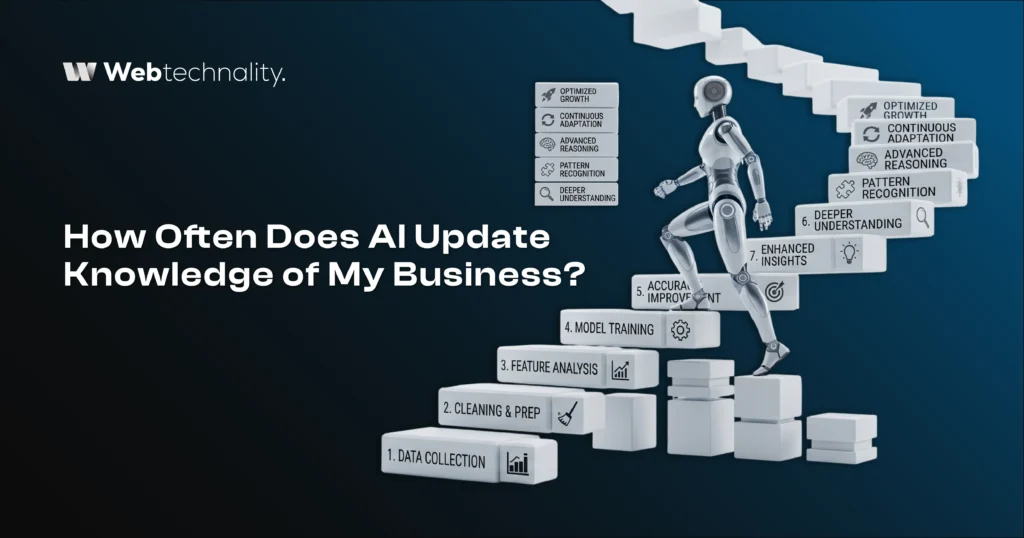
In 2026, the question “Is my business on Google?” has evolved into a much more complex inquiry: “What does the AI know about me?”
At Web Technality, we’ve seen a massive shift in how users discover services. They aren’t just scrolling through ten blue links on a search page; they are asking AI assistants for direct advice. For a brand like Web Technality or any business aiming for digital dominance, understanding the refresh rate of an Artificial Intelligence’s “brain” is the new frontier of SEO.
If you’ve recently updated your service list, changed your location, or launched a stunning new portfolio, you’re likely wondering: When will the AI start telling people about this?
This 2000-word deep dive will break down the mechanics of AI memory, the frequency of updates, and the steps you can take to ensure your business data is never obsolete.
The Three Layers of AI Memory
To understand how often AI updates, we must first dispel the myth that AI is a single, constantly flowing stream of information. In reality, AI models like Google Gemini and OpenAI’s GPT-5 operate using three distinct layers of knowledge. Each layer has a different “refresh rate.”
1. The Core Training Data (The “Hard Drive”)
This is the foundational knowledge the AI was born with. When a model is “trained,” it reads a massive snapshot of the internet.
- Frequency: Every 6 to 18 months.
- The Impact: If your business was founded after the training cutoff, the AI technically doesn’t “know” you in its base state. It relies entirely on the layers below to find you.
2. Retrieval-Augmented Generation / RAG (The “Library”)
RAG is the technology that allows an AI to look at external documents like your website before answering a question.
- Frequency: Daily to Weekly.
- The Impact: This is the most critical layer for Web Technality and our clients. When a user asks a specific question, the AI “retrieves” information from its indexed library. If your site is technically optimized, the AI can find your new data within hours.
3. Real-Time Web Browsing (The “Live Stream”)
Modern AI models can now “browse” the live web to answer questions about breaking news or current events.
- Frequency: Minutes to Hours.
- The Impact: This is used for high-urgency queries. However, because “browsing” is computationally expensive, AI doesn’t do this for every single question.
Update Frequency Comparison Table
The following table outlines the expected wait times for an AI to recognize changes to your brand, depending on where that information is hosted.
| Information Source | AI Recognition Speed | Influence Level | Reliability |
| Official Website | 12 – 48 Hours | Very High | Maximum |
| Google Business Profile | 1 – 6 Hours | Extremely High | High |
| Press Releases (News) | 2 – 12 Hours | High | Medium |
| LinkedIn/X (Social) | 1 – 4 Hours | Medium | Low |
| Third-Party Directories | 1 – 4 Weeks | Low | Medium |
Why Is My Business Info Outdated? The “Ghost” of Old Data
At Web Technality, a common frustration we hear from clients is: “I updated my website, but the AI is still quoting my old prices!”
This happens because of Data Persistence. AI models prioritize “consensus.” If 50 old directory sites (like Yelp or YellowPages) still have your old phone number, and only your website has the new one, the AI might assume the “majority” is correct.
This is why Citation Consistency is a core part of the Web Technality digital growth strategy. We don’t just update your site; we hunt down the “ghosts” of your old data across the web to ensure the AI sees a single, unified truth.
Controlling the Narrative: Generative Engine Optimization (GEO)
We are moving from Search Engine Optimization (SEO) to Generative Engine Optimization (GEO). In the past, you wanted to rank #1. Today, you want to be the “Suggested Answer.”
How GEO Works
GEO is the process of making your content easy for an AI to digest. AI models prefer content that is:
- Structured: Using clear headings and bullet points.
- Fact-Dense: Providing specific numbers, dates, and names.
- Authoritative: Backed by links from other trusted sources.
For example, when we design a site for a client, we don’t just write “We are good at design.” We write, “Our Houston-based agency increased client conversions by 42% in Q1 2026 using glassmorphism UI principles.” The latter is “AI-Food”—it contains entities, locations, and measurable facts.
The Role of Technical Infrastructure (The Web Technality Approach)
A beautiful website is useless if an AI bot can’t “read” it. The technical architecture of your site dictates how fast an AI updates its knowledge of you.
1. Schema Markup: The AI Cheat Sheet
A schema is a hidden layer of code that tells AI exactly what your content means.
- Without Schema: AI sees a string of numbers and guesses it’s a phone number.
- With Schema: You tell the AI, “This is the official phone number for Web Technality.”This removes the “guessing” and forces the AI to update its knowledge with 100% confidence.
2. The llms.txt File
In 2026, a new standard has emerged: the llms.txt file. Similar to a robots.txt file which tells search engines what to crawl, an llms.txt The file provides a concise, markdown-formatted summary of your business specifically for AI models to read.
3. Sitemap Pinging
Every time you update your site, your server should “ping” search engines. At Web Technality, we automate this process. The second a new blog post goes live, a signal is sent to the web crawlers, inviting them to come and see the new information.
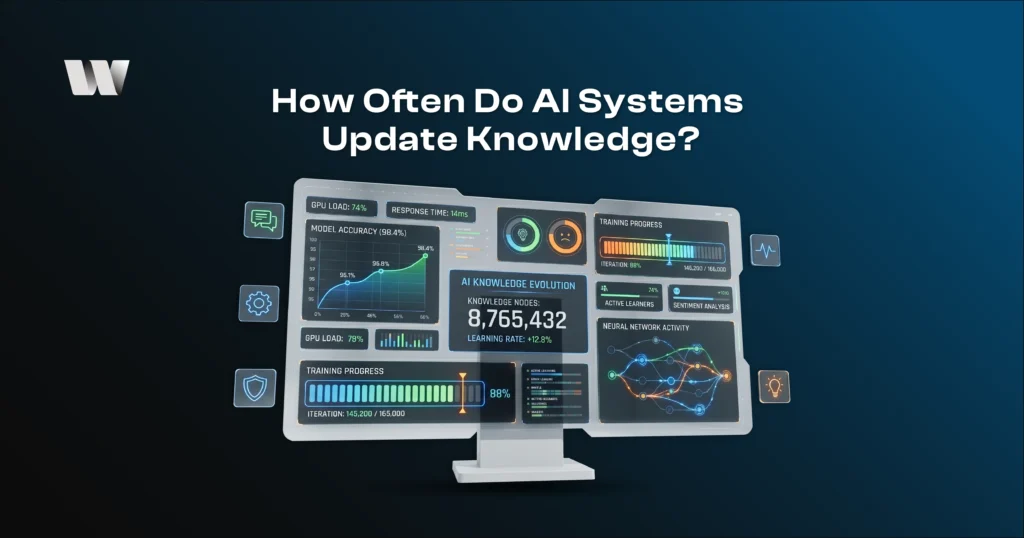
How Often Do AI Systems Update Knowledge?
AI systems can update their knowledge in different ways depending on their type and purpose. Here’s a look at the different update schedules and their impact on your business:
| Type of AI Update | Frequency of Update | Impact on Your Business |
|---|---|---|
| Real-Time Updates | Continuous, happening in real-time | Provides instant insights and immediate recommendations. Ideal for businesses that rely on quick decision-making. |
| Scheduled Updates | Updates occur on a daily, weekly, or monthly basis | Gives businesses updated data at regular intervals. Helps track long-term trends and performance. |
| Triggered Updates | Occur when specific data or events are detected | Updates occur when a specific action happens, like a customer purchase or product change. Ideal for tracking specific business changes. |
Step-by-Step: How to Force an AI Update
If you have urgent changes, follow this “Expert Checklist” to speed up the AI’s learning process:
- Update the “Source of Truth”: Change the info on your official website first.
- Submit to Search Console: Use Google Search Console to “Request Indexing.” This is the fastest way to get Google Gemini to see your changes.
- Refresh Google Business Profile: Google trusts its own platforms more than anything else. An update here often reflects in Gemini within the hour.
- Social Proofing: Share the update on LinkedIn and X. AI bots crawl these high-activity “social hubs” constantly.
- Press Release: For major changes (like a merger or new CEO), a distributed press release creates a “spike” in the data that AI models cannot ignore.
The Human Element: Why AI Still Needs You
While we often talk about “bots” and “crawlers,” the ultimate goal of AI is to serve humans. AI models are trained to look for E-E-A-T: Experience, Expertise, Authoritativeness, and Trustworthiness.
If your website feels like it was written by a robot for a robot, the AI will eventually deprioritize it. High-quality, human-written content like the work we produce at Web Technality always wins in the long run. The AI is smart enough to know when a human is sharing genuine expertise versus when a site is just “keyword stuffing.”
Future Outlook: Real-Time Business Syncing
As we look toward 2027 and beyond, the gap between “Web Update” and “AI Knowledge” will shrink to near zero. We are approaching a future where AI will be integrated directly into your business’s backend. Imagine an AI that knows your inventory is low because it’s connected to your Shopify, and automatically tells customers, “Web Technality’s ‘Design Sprint’ package is currently sold out, but will be back on Monday.”
This level of integration is what we strive for. Digital growth is no longer about a static website; it’s about a living, breathing data entity that communicates perfectly with the global AI network.
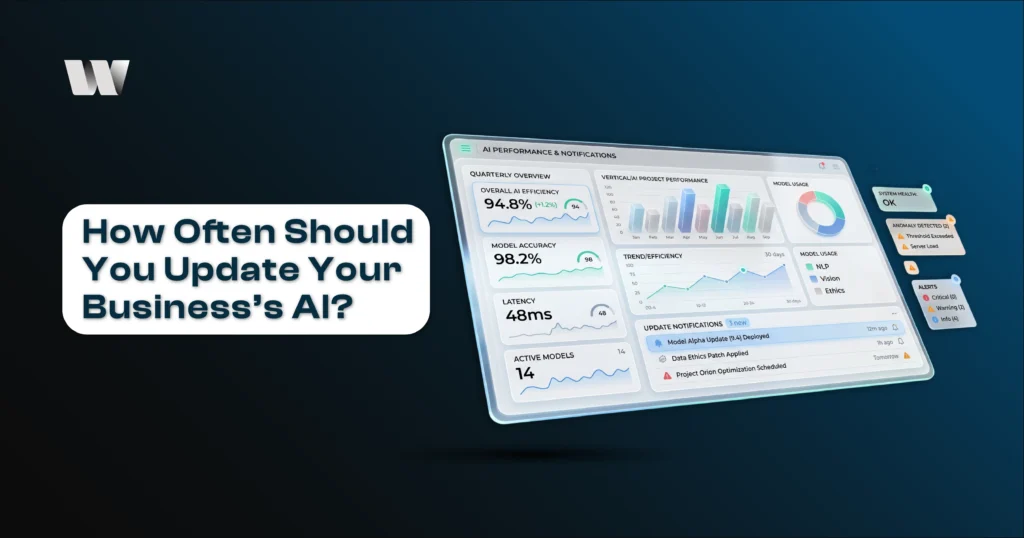
How Often Should You Update Your Business’s AI?
The answer depends on your business model and the type of AI you’re using. Real-time updates might be essential for businesses with immediate customer interaction, like e-commerce websites. On the other hand, if you’re analyzing long-term trends, scheduled updates could be a better fit.Best Practice: Small businesses should aim for a mix of real-time and scheduled updates. This ensures you’re responding to immediate customer needs while also having a solid understanding of longer-term trends.
Summary and Final Thoughts
To answer the original question: AI updates its knowledge of your business at varying speeds, ranging from a few minutes to several months.
However, you aren’t a passive observer in this process. By focusing on Technical SEO, Schema Markup, and Brand Consistency, you can “train” the AI to check your site more often.
At Web Technality, we specialize in this exact intersection of high-end design and AI-ready architecture. Whether you are looking to refresh your brand with Texas Logo Designs or build a complex digital ecosystem, our goal is to ensure that when a customer asks an AI for the best, the answer is always you.