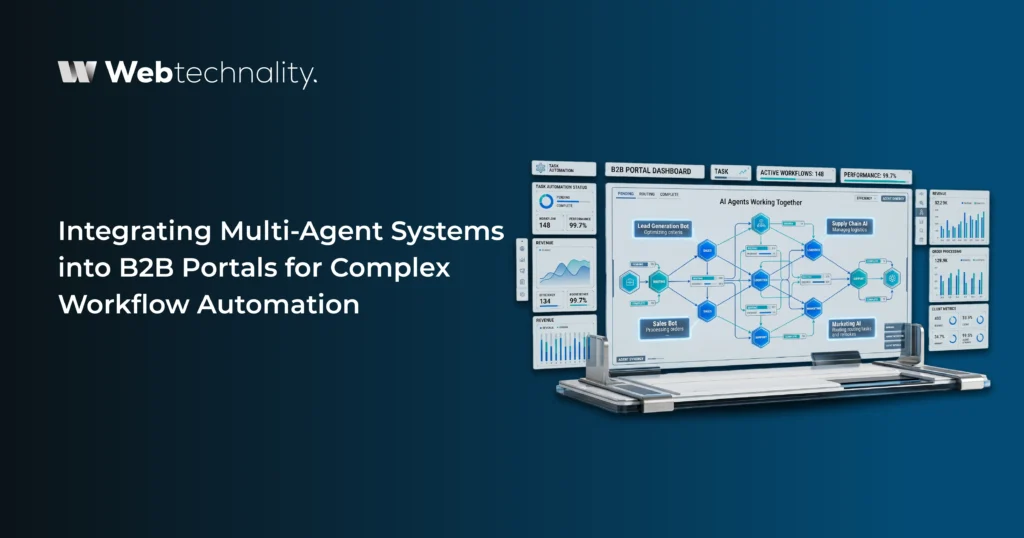
If you manage or operate a B2B portal, whether it is a supplier marketplace, a procurement platform, a client management hub, or an enterprise services portal, you already know the complexity problem firsthand.
B2B operations are not simple. Orders flow through multiple approval layers. Contracts need legal review. Invoices touch finance, logistics, and CRM simultaneously. Vendor onboarding involves compliance checks, document verification, and cross-department coordination. Every workflow has dependencies. Every dependency has exceptions.
For years, the answer was manual oversight, rigid rule-based automations, and a lot of human coordination holding it all together. That approach worked until the volume, complexity, and speed demands of modern B2B commerce made it unsustainable.
Now there is a better answer: multi-agent AI systems. And the B2B portals that adopt them first will pull ahead in ways that become very difficult to close.
Businesses that implement intelligent process automation at the B2B portal level see, on average, 40 to 60 percent reductions in workflow cycle times along with significant improvements in processing accuracy and partner satisfaction scores.
What Are Multi-Agent Systems?
A multi-agent system (MAS) is an architecture in which multiple AI agents, each with its own defined role, memory, and capabilities, work together to accomplish complex tasks that no single agent could handle alone.
Think of it like a well-run department within a company. The procurement agent handles vendor communication and purchase orders. The compliance agent reviews contracts against regulatory requirements. The finance agent validates invoices and flags discrepancies. The logistics agent tracks shipping and updates delivery timelines. Each agent has a specialized function, but they communicate, share context, and coordinate their outputs to drive a unified outcome.
What makes this different from traditional rule-based automation like Zapier workflows or robotic process automation is that AI agents can reason, not just react. They handle exceptions, interpret ambiguous inputs, make judgment calls within defined parameters, and escalate when they encounter something outside their scope.
For B2B portals dealing with high-complexity workflows, variable pricing, tiered approvals, dynamic compliance requirements, and multi-party contracts, this distinction is everything.
Why B2B Portals Specifically Need Multi-Agent Architecture
Most workflow automation tools were built for B2C simplicity or internal corporate tasks. They struggle with the structural complexity of B2B environments for very predictable reasons.
- Multiple Parties, Multiple Contexts: B2B portals involve buyers, sellers, partners, and internal teams, each with different roles, permissions, and data contexts. Multi-agent systems assign dedicated agents to each stakeholder context, keeping orchestration clean and accurate.
- Non-Linear Workflows: B2B processes rarely flow in a straight line. A purchase order might branch into parallel approval tracks, trigger a credit check, require vendor confirmation, and simultaneously notify logistics, all before a single line item is confirmed. Multi-agent systems handle branching, parallel execution, and conditional logic naturally.
- Volume and Variability: Enterprise B2B portals process thousands of transactions with high variability across product types, contract terms, regional regulations, and customer tiers. Multi-agent systems scale to this volume without degradation.
- Compliance and Audit Requirements: B2B operations require detailed audit trails and regulatory compliance documentation. Multi-agent systems log every decision, flag every exception, and generate compliance reports automatically.
According to Forrester’s 2026 B2B Automation Report, 67% of enterprise B2B portal operators cite workflow bottlenecks as their top operational challenge. Multi-agent systems directly address every category of bottleneck identified in the report.
Multi-Agent AI vs Traditional Automation
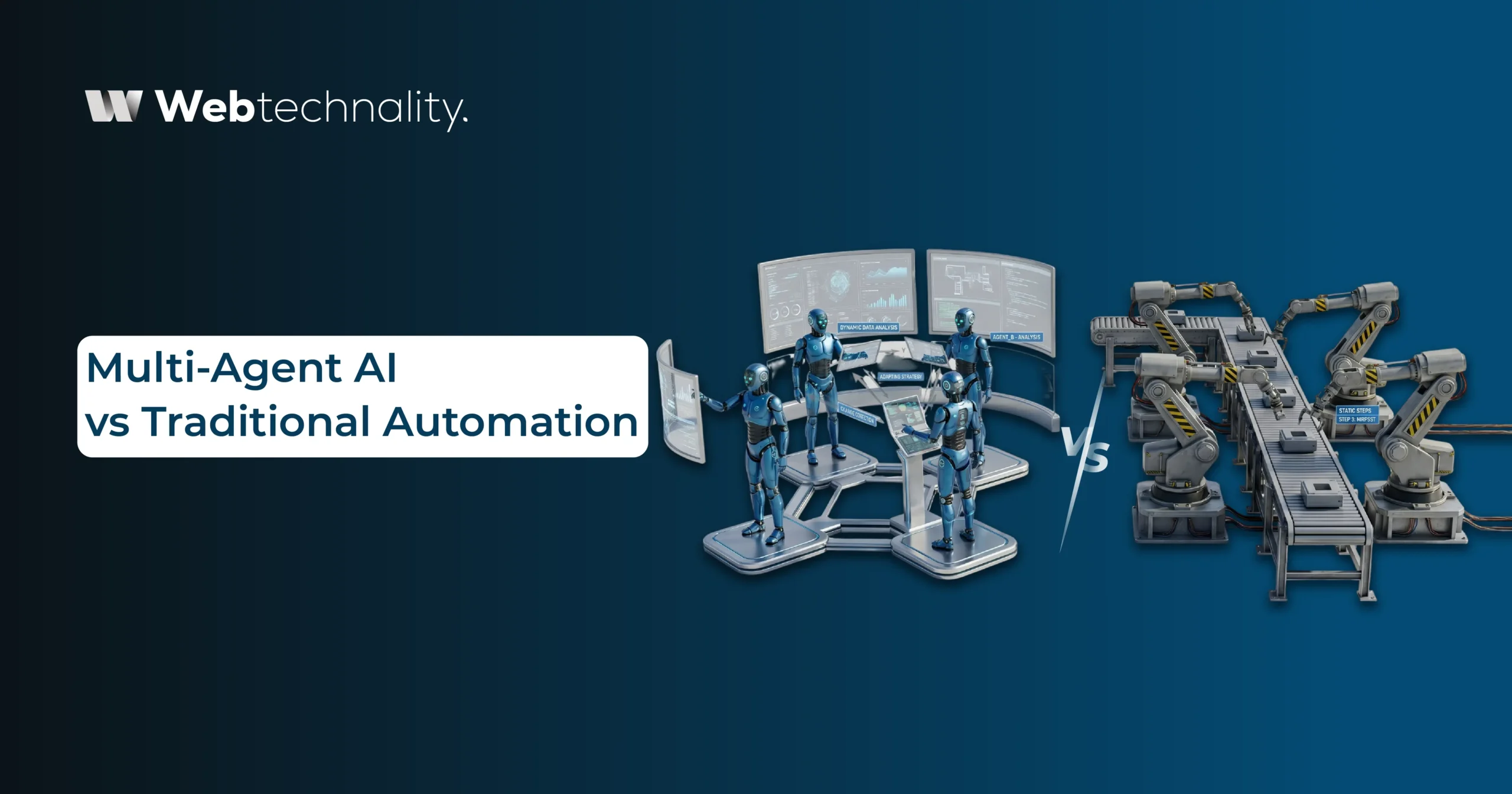
Understanding where traditional automation falls short helps clarify exactly where multi-agent systems deliver transformative value.
| Capability | Traditional Automation (RPA / Rules) | Multi-Agent AI Systems |
|---|---|---|
| Exception handling | Fails or escalates immediately | Reasons through exceptions autonomously |
| Workflow complexity | Linear processes only | Parallel, branching, and conditional flows |
| Adaptability | Requires manual rule updates | Adapts to new conditions dynamically |
| Multi-system coordination | Limited, brittle integrations | Robust orchestration across all systems |
| Natural language understanding | None, structured inputs only | Reads and interprets documents and messages |
| Audit and compliance | Basic logs only | Full decision-level audit trails |
| Learning and improvement | Static until manually updated | Improves with feedback and monitoring |
The fundamental difference: traditional automation executes fixed instructions. Multi-agent AI systems understand goals and figure out how to achieve them, even when conditions change.
5 Real B2B Workflows That Multi-Agent Systems Automate
Let us get concrete. Here are the workflows where multi-agent AI delivers the most dramatic impact inside B2B portals right now.
🏭 1. Procurement and Purchase Order Management
A procurement agent monitors approved vendor lists, checks inventory levels, triggers reorder requests when thresholds are hit, and routes purchase orders through the appropriate approval chain based on value, category, and cost center. An approval agent validates authority levels and escalates exceptions. A vendor communication agent sends order confirmations and tracks acknowledgment. The entire cycle runs without a single human initiating it.
Result: Procurement cycles that took 3 to 5 days reduced to hours, with full auditability at every step.
🔎 2. Vendor Onboarding and Compliance Verification
Onboarding a new B2B vendor typically involves document collection, identity verification, regulatory compliance checks, tax registration validation, and internal approval workflows. A multi-agent system coordinates all of these simultaneously. One agent handles document intake, another runs compliance checks against regulatory databases, a third validates financial standing, and an orchestrator agent manages the overall status and communicates next steps to the vendor.
Result: A process that typically takes weeks now completes in days, or less, with no manual coordination required.
📄 3. Contract Review and Lifecycle Management
An AI legal review agent reads incoming contracts, compares clauses against your approved terms, flags deviations, and produces a redline summary for human review. A lifecycle agent tracks contract expiry dates, renewal windows, and SLA obligations, triggering alerts and actions at the appropriate time. Our custom AI solutions team integrates these workflows directly into your B2B portal, connecting AI contract agents with your existing CRM and document management system.
Result: Missed renewals and contract drift become a thing of the past. Legal review cycles shrink from days to hours.
💰 4. Invoice Processing and Accounts Payable
Three-way matching (purchase order vs. delivery receipt vs. invoice) is time-consuming but critical. A multi-agent system automates this entirely: a data extraction agent parses incoming invoices in any format, a matching agent compares line items against POs and delivery confirmations, a discrepancy agent flags and investigates mismatches, and a payment agent queues approved invoices for settlement. This eliminates a process that traditionally requires a dedicated AP team to manage at scale.
Result: Invoice processing time cut by up to 80%, with dramatically fewer payment errors and disputes.
🎧 5. Customer Support and Complex Order Management
In B2B environments, support tickets often require information from multiple systems simultaneously. A multi-agent support architecture assigns specialist agents to each data domain and uses an orchestrator to synthesize a complete, accurate response. Your portal handles highly specific, multi-part inquiries with near-instant accuracy, freeing your human support team for genuine relationship management and escalation handling.
Result: First-response time drops to seconds. Customer satisfaction scores improve measurably within the first quarter.
How to Architect a Multi-Agent System for Your B2B Portal
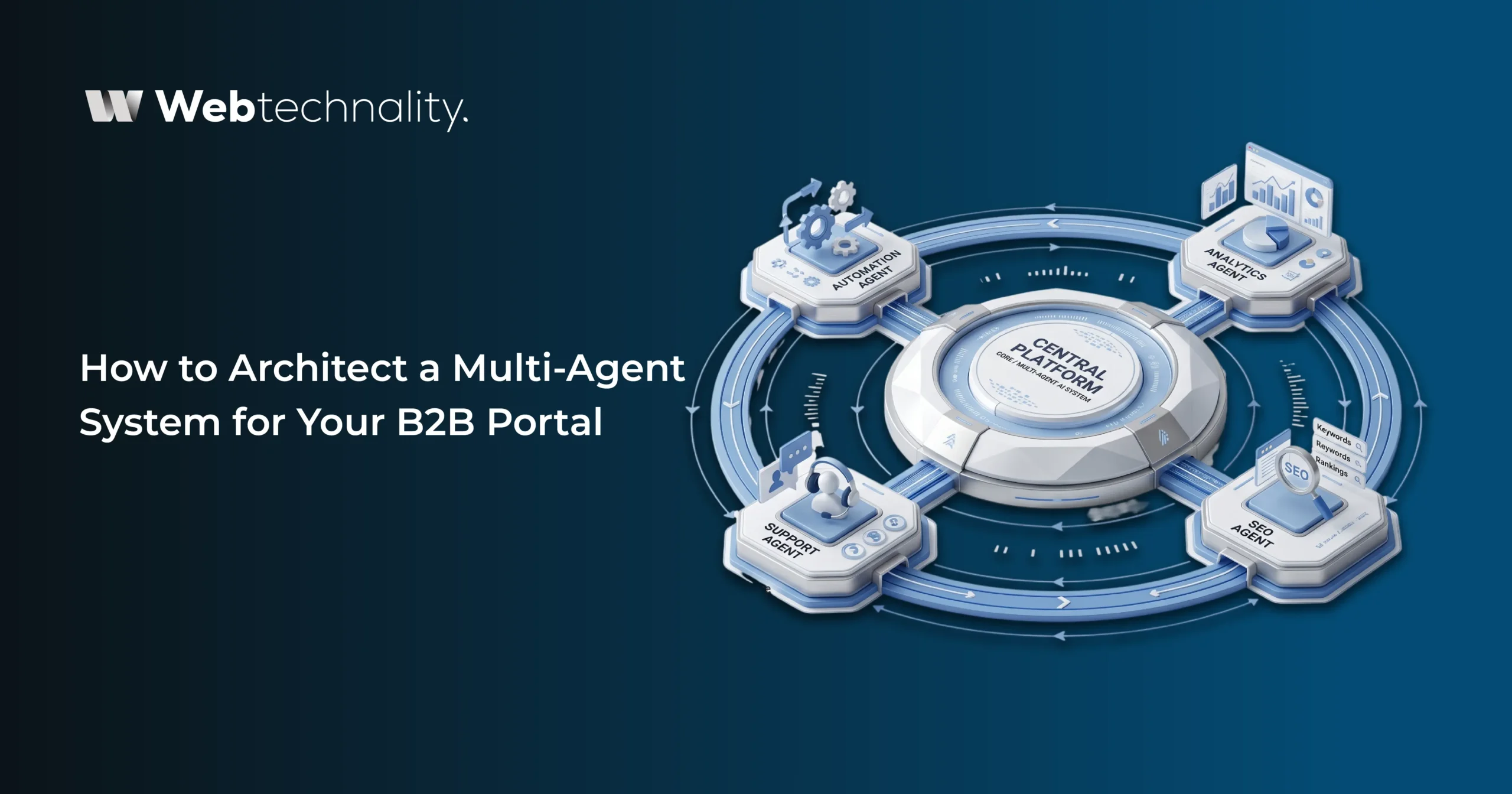
Getting this right requires thoughtful design upfront. Here is the six-step framework we use at Webtechnality when building multi-agent integrations for enterprise B2B platforms.
Step 1: Map Your Workflows in Detail
Before writing a single line of code or configuring a single agent, document every workflow you want to automate. For each workflow, identify the trigger event, every step and decision point, every stakeholder and system involved, and every exception or edge case. This workflow map becomes the architectural blueprint for your entire agent design.
Step 2: Define Agent Roles and Boundaries
Each agent should have a clearly defined scope. Resist the urge to build one super-agent that does everything. This creates complexity, brittleness, and debugging nightmares. Good agent design is like good organizational design: specialized roles, clear responsibilities, and defined escalation paths.
Step 3: Design the Orchestration Layer
The orchestration layer is the intelligence that coordinates your agents. It routes tasks to the right agents, manages context passing between them, handles sequencing, and manages failure states. A poorly designed orchestrator creates bottlenecks and inconsistent behavior. Our AI development team specializes in building robust orchestration layers for enterprise B2B environments where failure is not an option.
Step 4: Integrate with Existing Systems
Your multi-agent system needs to connect to your existing data: ERP, CRM, document storage, communication platforms, and financial systems. This requires well-designed API integrations, data normalization, and often a middleware layer that translates between legacy systems and your AI agents. Our full-stack development team handles these integrations as part of a unified project scope, ensuring your AI layer and existing infrastructure work together seamlessly from day one.
Step 5: Build Human-in-the-Loop Checkpoints
Not every decision should be fully automated. Build deliberate escalation points where AI agents pause and hand off to human reviewers, particularly for high-value transactions, unusual exceptions, and regulatory decisions. The best B2B automation systems augment human judgment rather than replace it entirely. Getting this balance right dramatically improves adoption and organizational trust.
Step 6: Instrument for Observability
You need to know what your agents are doing, why they are doing it, and when they have encountered a problem. Build logging, alerting, and dashboard visibility into every agent from the start. This is critical for debugging, compliance auditing, and continuous improvement. What you can measure, you can optimize.
Start with one high-volume, well-defined workflow rather than trying to automate everything at once. A successful first deployment builds organizational confidence, proves ROI, and makes it much easier to scale to additional workflows over time.
The Competitive Advantage of Getting Here First
Here is what the data tells us: businesses that implement intelligent process automation at the B2B portal level see, on average, 40 to 60 percent reductions in workflow cycle times, significant decreases in manual processing errors, and meaningful improvements in customer and partner satisfaction scores.
But the real advantage is not operational efficiency. It is strategic capacity.
When your procurement, compliance, vendor management, and support workflows are handled by intelligent agents, your people are freed to focus on strategic relationships, product development, and growth. You go from an organization constantly fighting operational fires to one consistently building forward.
Your competitors who have not made this shift are still hiring coordinators to manage spreadsheets. You are running an intelligent platform that scales without proportional cost increases. That gap only widens over time.
Companies deploying multi-agent systems in B2B portal workflows report an average 58% reduction in process cycle time, 43% fewer human errors in transaction processing, and 31% lower operational costs per transaction within the first year of deployment.
Frequently Asked Questions
What is a multi-agent system in the context of B2B portals?
A multi-agent system is an AI architecture where multiple specialized AI agents work together to handle complex, multi-step workflows. In a B2B portal, this might include separate agents for procurement, compliance, invoice processing, vendor communication, and customer support, all coordinated by a central orchestration layer that manages sequencing and context.
How is multi-agent automation different from traditional workflow automation?
Traditional automation tools follow fixed rules and cannot handle exceptions, ambiguity, or changing conditions. Multi-agent AI systems can reason through complex scenarios, handle edge cases, and adapt to new information, making them far more effective for the high variability that is normal in B2B operations.
Is multi-agent AI integration suitable for small and mid-sized B2B businesses?
Yes, though the scope should be matched to business size. Mid-market B2B businesses can start by automating one or two high-volume workflows like vendor onboarding or invoice processing before scaling to broader automation. The ROI at even modest scale is typically significant, with most businesses recovering their investment within 6 to 12 months.
How long does it take to build a multi-agent system for a B2B portal?
A focused multi-agent implementation for one or two workflows typically takes 6 to 10 weeks. More comprehensive enterprise automation projects with multiple integrations and agent types may take 3 to 6 months to design, build, test, and deploy properly. Webtechnality provides detailed project scoping so you know exactly what to expect before work begins.
Can Webtechnality integrate multi-agent systems with our existing ERP or CRM?
Yes. Webtechnality specializes in connecting AI agent architectures with existing enterprise systems including ERP, CRM, document management, and financial platforms. Our full-stack development team designs integration layers that allow your agents to access and update data across your entire technology stack without requiring core system replacements.
What industries benefit most from multi-agent B2B automation?
Logistics, manufacturing, procurement, financial services, healthcare supply chains, professional services, and technology distribution see the highest ROI from multi-agent automation. However, any B2B environment with complex, multi-party workflows and high transaction volume can benefit significantly from this technology.
Do multi-agent systems require replacing existing technology stacks?
No. Multi-agent systems are designed to integrate with and augment existing technology. The AI layer sits on top of your current ERP, CRM, and workflow tools, reading from and writing to them through APIs and integration layers. You keep what works and add intelligence on top of it.
The Bottom Line
B2B portals have always been complex. But complexity should not mean slow, expensive, and error-prone. Multi-agent AI systems are the technology that finally makes sophisticated B2B operations possible at the speed and scale modern business demands.
The organizations winning in 2026 are not the ones with the biggest teams. They are the ones with the most intelligent platforms. And those platforms are being built right now.
Your Next Steps:
- Map your highest-friction workflows: Find the processes that consume the most human time and have the most exceptions
- Identify your integration touchpoints: List every system your agents will need to connect to
- Define your success metrics: Decide what cycle time reduction, error rate, and cost savings mean for your business
- Choose your starting workflow: Pick one well-defined, high-volume process to automate first
- Talk to a development partner: Get a technical assessment and project roadmap before committing to a build
About Webtechnality
Webtechnality is a full-service digital agency in Arizona, specializing in AI development, web app development, ecommerce, and digital marketing. With 10+ years of experience and 5,000+ projects delivered across logistics, manufacturing, finance, healthcare, and professional services, we build intelligent B2B platforms that give businesses a measurable operational and competitive edge.