Every day, hundreds of people visit your website. Some are casually browsing. Some are doing early-stage research. And some, right now, are actively comparing you to your competitors, ready to make a decision within the next 48 hours.
The problem is: you probably cannot tell them apart. And because you cannot tell them apart, your sales team is spending the same amount of time on a cold prospect who just stumbled onto your blog as they are on a decision-ready buyer in the final stage of their evaluation. That is an expensive mistake. And in 2026, it is also a completely avoidable one.
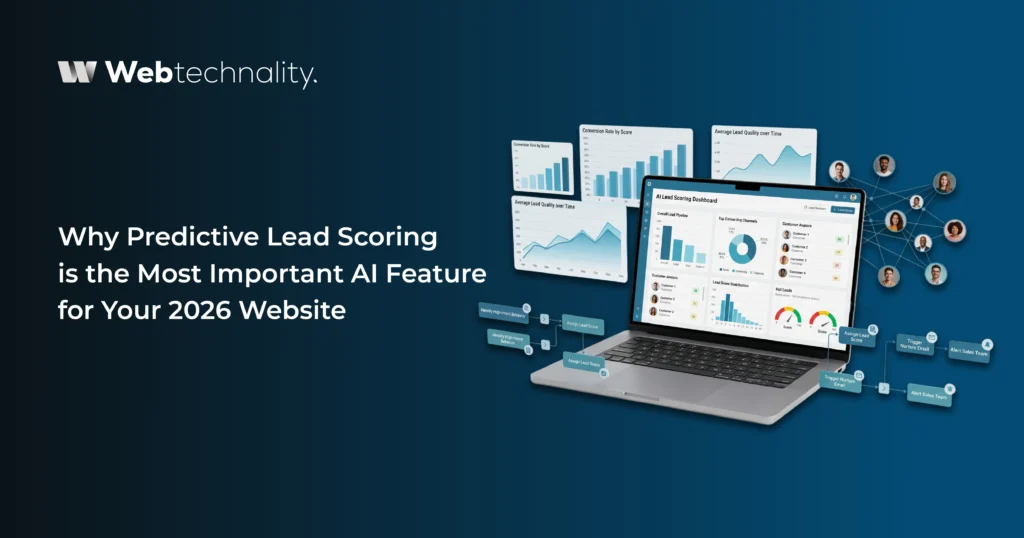
Predictive lead scoring is the AI feature that changes this equation entirely. It does not just tell you who filled out a form. It tells you who is actually ready to buy, ranked in real time, before your competitor even calls them back.
At Webtechnality, we have built and integrated predictive lead scoring systems for B2B and B2C businesses across industries. The results are consistently the same: sales teams close more deals, in less time, with less wasted effort. Here is everything you need to know about why this is the single most important AI investment your website can make this year.
Businesses that implement intelligent process automation at the B2B portal level see, on average, 40 to 60 percent reductions in workflow cycle times along with significant improvements in processing accuracy and partner satisfaction scores.
What is Predictive Lead Scoring?
Predictive lead scoring is an AI-driven system that evaluates every lead or website visitor based on a combination of behavioral signals, firmographic data, and historical conversion patterns to assign a score that reflects how likely they are to become a customer.
Think of it as your smartest sales analyst working around the clock, looking at every data point your website and CRM generate, identifying patterns that correlate with conversion, and then using those patterns to rank your entire pipeline in real time.
When a lead from a mid-sized manufacturing company in Texas visits your pricing page three times in two days, downloads your case study, and opens every email in your nurture sequence, that behavior means something very specific. Predictive lead scoring captures that signal, weighs it against thousands of similar conversion patterns in your historical data, and surfaces that lead at the top of your sales queue before anyone has to manually review a spreadsheet.
The model does not need to be told what good behavior looks like. It figures that out from your data. And it gets better the more conversions it observes. That is what separates it fundamentally from every scoring approach that came before it.
Traditional Lead Scoring vs Predictive Lead Scoring
To understand why predictive scoring matters so much in 2026, you first need to understand why the old way of doing it has become a liability rather than an asset.
| Factor | Traditional Lead Scoring | Predictive Lead Scoring |
|---|---|---|
| How scores are set | Manually assigned point values by marketing team | Automatically learned from real conversion data |
| Accuracy | Based on assumptions, often outdated | Based on actual patterns that drove past conversions |
| Maintenance | Requires regular manual updates to stay relevant | Self-updating as new conversion data flows in |
| Data used | Limited to form fills and basic demographics | Full behavioral, firmographic, and intent data |
| Speed | Static scores, updated manually or on a schedule | Real-time scoring that updates with every interaction |
| Scale | Breaks down with high lead volume | Becomes more accurate with higher volume |
| Bias | Reflects human assumptions, not actual buyer behavior | Reflects what actually predicts conversion in your market |
The core problem with traditional scoring is that it tells you what your marketing team thinks a good lead looks like. Predictive scoring tells you what your conversion history proves a good lead looks like. That is a completely different level of insight, and in a competitive market, that difference shows up directly in your close rate.
The Data Signals That Drive Predictive Scoring
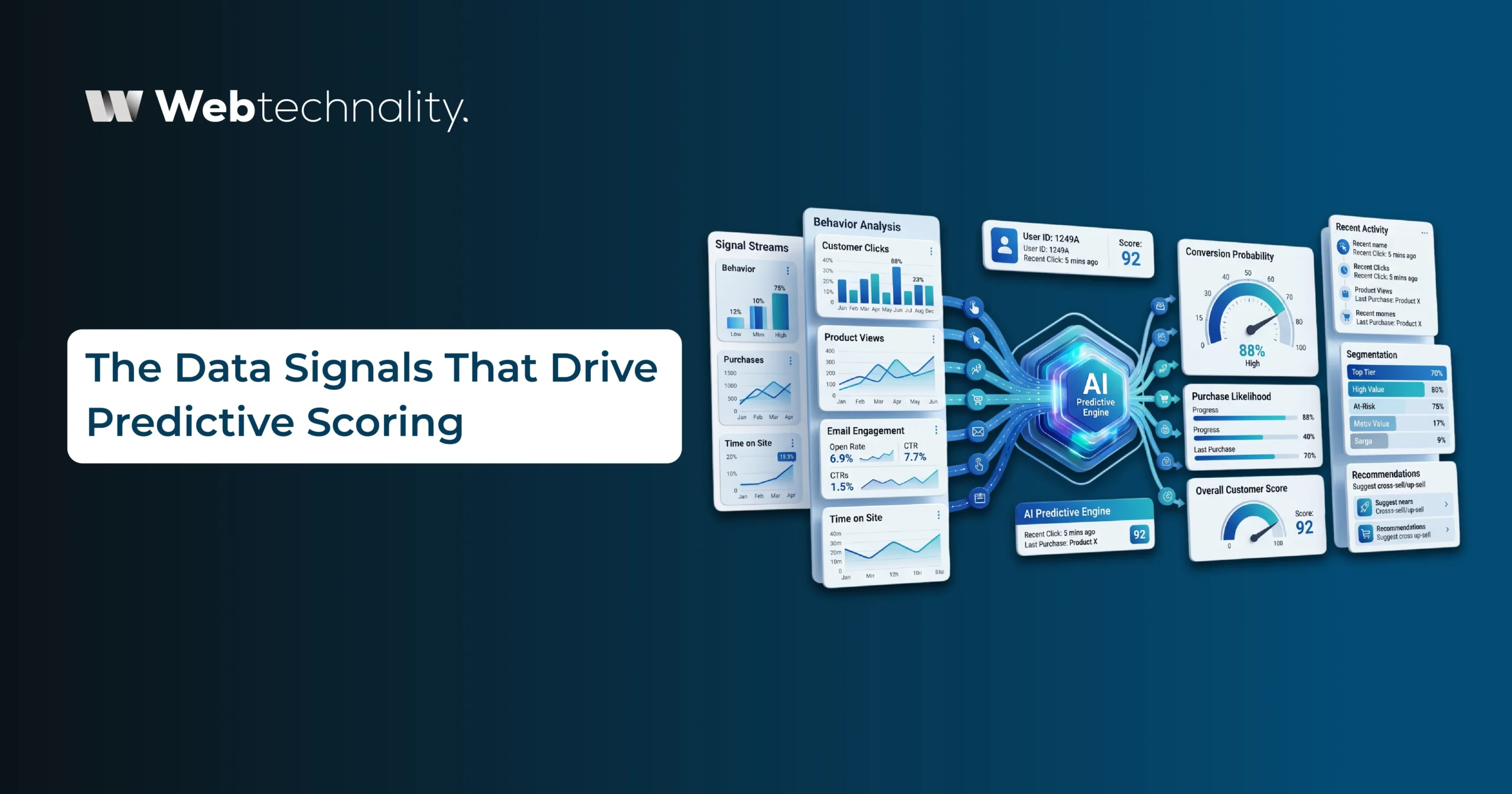
One of the most common questions we hear from business owners is: What data does predictive lead scoring actually use? The answer is more comprehensive than most people expect, and that breadth of signal is precisely what makes it so powerful.
🖱️ Behavioral Signals (On-Site Activity)
Every action a visitor takes on your website carries intent information. Which pages they visit and how many times, how long they spend on pricing or product pages, whether they watched a demo video all the way through, what they searched for in your site search, what content they downloaded, and how frequently they return are all weighted signals the model learns to interpret based on how those behaviors correlated with conversion in your historical data.
📧 Email and Content Engagement
Email open rates, click-through patterns, specific links clicked within emails, and responses to nurture sequences are extremely high-signal behaviors. A lead that opens every email but never clicks is different from a lead that clicks one specific email about pricing. Predictive scoring knows the difference and weights them accordingly.
🏢 Firmographic and Demographic Data
For B2B businesses, company size, industry, location, technology stack, and annual revenue are strong predictors of conversion when combined with behavioral signals. For B2C, demographic patterns from your existing customer base inform which profile types convert at higher rates. This data comes from your CRM, third-party enrichment tools, and form data combined.
📍 Intent and Third-Party Data
In 2026, predictive scoring systems can also incorporate intent data from third-party providers that tracks when companies are actively researching topics related to your product category across the web. A lead that is already in active research mode on the broader internet before they even visit your site starts with a higher baseline score.
📊 CRM and Sales History
Your historical win and loss data is the training foundation of the entire model. The system learns which combinations of signals actually produced closed deals versus which combinations produced leads that went cold, and it continuously refines those predictions as new outcomes flow in.
Predictive scoring models that incorporate behavioral, firmographic, and intent data simultaneously are 3.2x more accurate at predicting conversion than models using behavioral data alone, according to a 2025 Gartner analysis of B2B lead scoring systems.
Why It is the Most Important AI Feature in 2026
There are a lot of AI features competing for your website budget in 2026. AI Chatbots Developmen, recommendation engines, personalization layers, automated content generation, voice search optimization, and more. So why does predictive lead scoring sit at the top of the list?
Because it is the only AI feature that directly and measurably improves your revenue by changing what your sales team does with their time.
1. It Solves the Biggest Problem in B2B Sales
The single most expensive thing a sales team can do is spend quality time on a lead that was never going to buy. Predictive scoring eliminates this problem at the source. Your reps stop working cold lists and start working ranked lists where the top entries represent your most conversion-ready opportunities. That shift alone typically improves close rates by 20 to 40 percent in the first two quarters.
2. It Creates a Revenue-Driven Feedback Loop
Unlike most website features that operate independently, predictive lead scoring connects your marketing and sales data into a single learning system. Every deal your sales team closes or loses feeds back into the model, making its predictions more accurate over time. Your website gets smarter every day without any manual intervention.
3. It Works While You Sleep
Predictive scoring runs continuously in the background. When a high-intent lead reaches your threshold score at 11pm on a Friday, your system can automatically trigger a personalized email sequence, notify the right sales rep for Monday morning follow-up, or even initiate an AI-driven conversation through your website. You do not need someone watching the dashboard. The system acts on your behalf.
4. It Makes Every Other AI Feature More Effective
Predictive scoring does not just benefit your sales team. They develop your chatbot smarter by telling it which visitors deserve a VIP response. It will make your personalization engine more relevant by telling it which content a high-scoring visitor should see next. and also makes your ad retargeting more efficient by excluding low-probability leads from expensive remarketing campaigns. It is the intelligence layer that ties your entire digital strategy together.
5. Your Competitors Are Already Building It
Early movers on predictive scoring do not just improve their own conversion rates. They pull ahead of competitors who are still treating every lead identically. In a market where two similar companies are both reaching out to the same buyer, the one that reaches out first, with the most relevant message, at exactly the right moment, wins the deal. Predictive scoring makes that precision possible at scale.
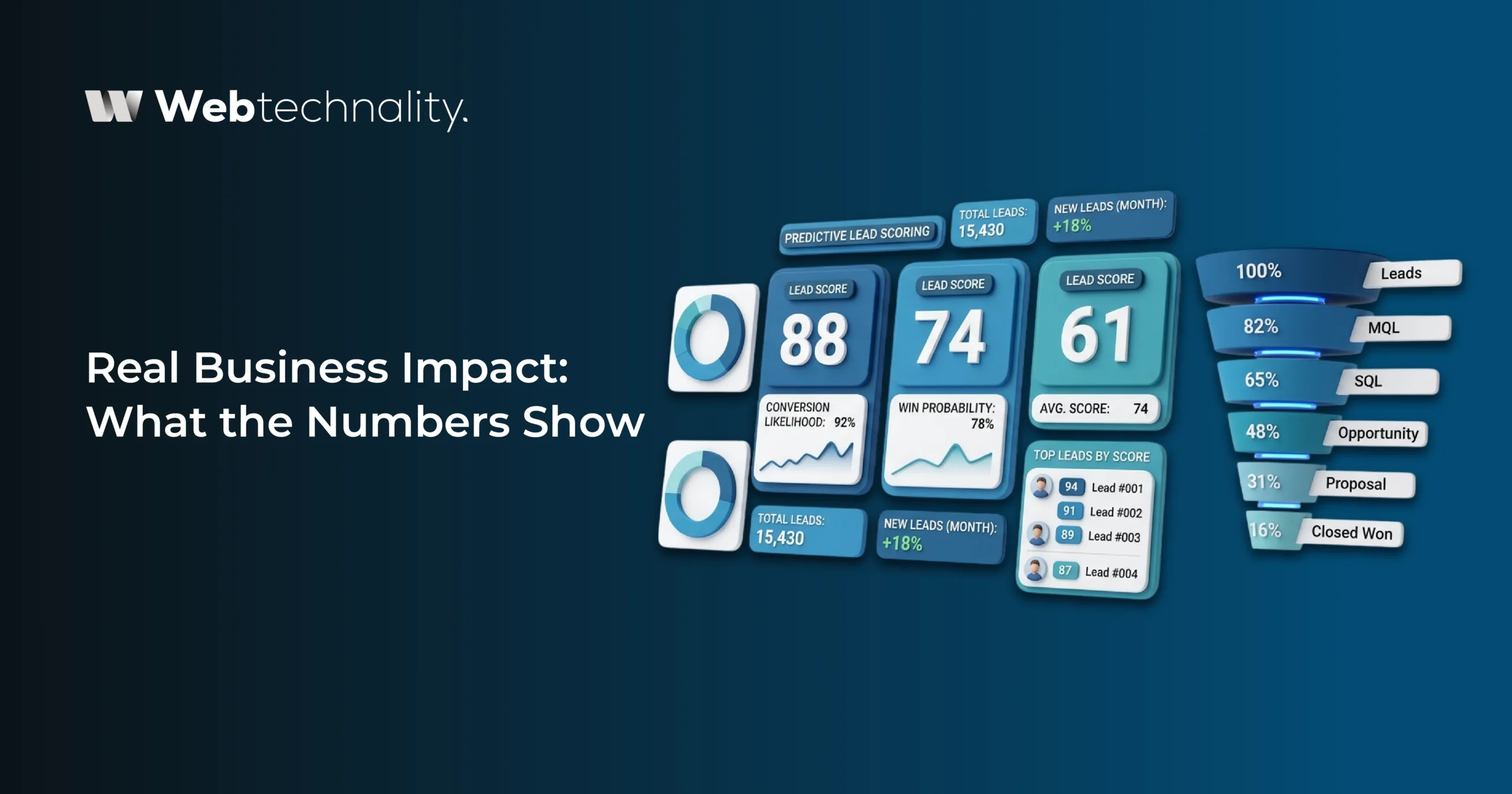
Real Business Impact: What the Numbers Show
Predictive lead scoring is not a theoretical improvement. The results businesses report after implementation are consistently strong and show up quickly in measurable revenue metrics.
A B2B SaaS company with a 12-person sales team implements predictive scoring across their inbound lead flow. Within two quarters, their sales-qualified lead to close rate increases from 18% to 29%. The same number of leads, the same sales team, but the reps are now spending their time on a fundamentally different quality of opportunity. Annual revenue grows by 34% with zero additional headcount.
A professional services firm that was previously nurturing all leads equally uses predictive scoring to segment their pipeline into three tiers. Their top-tier leads receive immediate personal outreach. Their mid-tier leads enter a high-touch automated sequence, and low-tier leads enter a long-term nurture program with minimal sales involvement. The sales team’s average deal cycle shortens from 67 days to 41 days, and revenue per sales rep increases by 31% in the first year.
An e-commerce business selling B2B office supplies uses predictive scoring to identify which business accounts are approaching reorder thresholds before they go elsewhere. Proactive outreach to high-score accounts improves retention by 24% and increases average order value by 18% because reps are reaching out at the moment of highest purchase intent.
Businesses using predictive lead scoring report on average a 20 to 40 percent improvement in sales conversion rates, 30 to 50 percent reduction in time wasted on unqualified leads, and 15 to 35 percent increase in average deal size due to better-timed outreach and more relevant conversations.
How to Implement Predictive Lead Scoring on Your Website
The implementation process is more structured than most people expect. Here is how Webtechnality approaches it when building predictive scoring for client websites and portals.
Step 1: Audit Your Data Infrastructure
Predictive scoring requires clean, connected data. Before any model is built, we audit your CRM for completeness, your website analytics for behavioral tracking coverage, your email platform for engagement data availability, and your historical win and loss records. Gaps are identified and addressed first. A model built on incomplete data produces unreliable scores.
Step 2: Define Your Ideal Customer Profile
We work with your sales team to document the characteristics of your highest-value customers: company size, industry, decision-maker roles, typical deal size, and deal velocity. This profile informs the initial model configuration and ensures the AI is learning to identify leads that match your actual business goals, not just any conversion.
Step 3: Build and Train the Scoring Model
Using your historical conversion data, we build and train the machine learning model that will power your scoring engine. This involves selecting the right modeling approach for your data volume and lead type, engineering the feature set that captures your highest-signal behaviors, and validating accuracy against held-out historical data before going live.
Step 4: Integrate with Your CRM and Website
The scoring model connects to your website via event tracking, to your CRM via API integration, and to your email platform for engagement data. Webtechnality’s web development team handles all integration work, ensuring scores update in real time as new interactions occur and surface directly inside the tools your sales team already uses.
Step 5: Define Score-Based Workflows and Triggers
The scoring system becomes fully operational when it drives action. We configure automated workflows based on score thresholds: high-score leads trigger immediate sales notifications, medium-score leads enter accelerated email sequences, and low-score leads enter longer-term nurture programs. These workflows mean the system is actively working your pipeline 24 hours a day.
Step 6: Monitor, Refine, and Scale
After launch, we monitor model performance, compare predicted scores against actual conversion outcomes, and continuously refine the model as more data accumulates. We also build dashboard visibility so your team can see pipeline health, score distributions, and the quality of leads entering each stage of your sales funnel at any time.
Most predictive lead scoring implementations take 4 to 8 weeks from data audit to live deployment. Businesses typically see measurable improvements in sales efficiency within the first 30 days after go-live, with full model accuracy typically achieved after 90 days of live conversion data flowing through the system.
Frequently Asked Questions
What is predictive lead scoring?
Predictive lead scoring is an AI-driven process that analyzes behavioral, firmographic, and historical data to automatically assign a score to each website visitor or lead based on how likely they are to convert into a paying customer. Unlike manual scoring, it updates in real time as new data comes in and improves continuously as more conversion outcomes are recorded.
How is predictive lead scoring different from traditional lead scoring?
Traditional lead scoring relies on manually assigned rules and static point values set by marketing teams. Predictive lead scoring uses machine learning to automatically identify which signals actually correlate with conversion, continuously updating as your customer data evolves. It is more accurate, more scalable, and does not require constant manual maintenance.
What data does predictive lead scoring use?
Predictive lead scoring draws on behavioral signals such as pages visited, time on site, content downloaded, email open rates, and form interactions, as well as firmographic data like company size, industry, and job title, and historical conversion data from your CRM. Advanced implementations also incorporate third-party intent data from companies actively researching your product category.
Is predictive lead scoring only for large enterprises?
No. While enterprise companies benefit greatly, any B2B or B2C website generating consistent lead volume can see strong ROI from predictive lead scoring. The minimum viable data set is smaller than most businesses expect, and the technology has become accessible and affordable at every business tier in 2026.
How long does it take to implement predictive lead scoring?
A basic predictive lead scoring integration typically takes 4 to 8 weeks depending on the complexity of your CRM, the volume of historical data available, and the number of touchpoints being tracked. Webtechnality handles the full implementation from data architecture to dashboard delivery and ongoing optimization.
What ROI can I expect from predictive lead scoring?
Businesses implementing predictive lead scoring typically report 20 to 40 percent higher sales conversion rates, 30 to 50 percent reductions in time spent on unqualified leads, and significant revenue increases within the first two quarters. Exact figures depend on your current sales process maturity and lead volume.
Does predictive lead scoring work with my existing CRM?
Yes. Predictive lead scoring is designed to integrate with major CRM platforms including Salesforce, HubSpot, Zoho, Pipedrive, and custom-built CRM systems. Webtechnality builds integration layers that connect your lead scoring engine directly to your existing sales workflow so your team sees scores without changing the tools they use every day.
The Bottom Line
In 2026, your website generates more data about your visitors than ever before. The question is whether you are turning that data into decisions, or letting it sit unused in your analytics dashboard while your competitors out-prioritize and out-time you on every deal.
Predictive lead scoring is the AI feature that bridges the gap between data and revenue. It takes everything your website knows about every visitor and translates it into a single, actionable number that tells your sales team exactly where to focus, right now, today.
No other AI feature your website can have in 2026 has a more direct, measurable, and provable line to revenue. That is why it sits at the top of the list.
Your Next Steps:
- Audit your current scoring approach: Is it rule-based, manual, or non-existent? Identify the gap.
- Assess your data readiness: Do you have at least 6 months of CRM win and loss data? That is your starting point.
- Map your lead journey: Document every touchpoint where your website collects behavioral signal data.
- Define your threshold actions: Decide what should happen automatically when a lead reaches a high-score threshold.
- Talk to a development partner: Get a technical assessment of what a custom predictive scoring system would look like for your specific business.
About Webtechnality
Webtechnality is a full-service digital agency in Arizona, specializing in AI development, web app development, ecommerce, and digital marketing. With 10+ years of experience and 5,000+ projects delivered across logistics, manufacturing, finance, healthcare, and professional services, we build intelligent B2B platforms that give businesses a measurable operational and competitive edge.