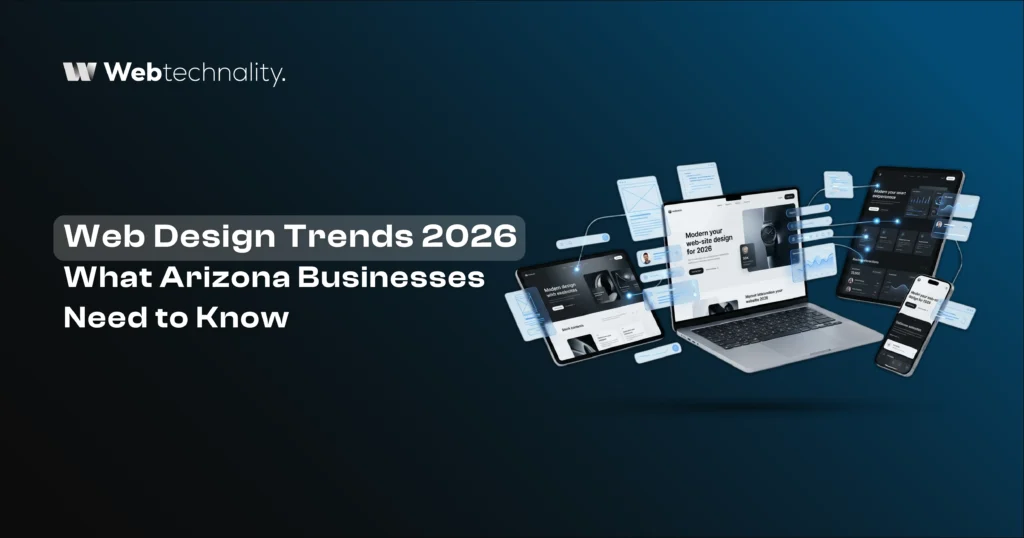
The web design trends 2026 have brought are not just about looking good; they are about converting visitors into customers faster than ever before. Whether you run a small business in Kingman, a startup in Phoenix, or a growing company in Scottsdale, staying ahead of these trends can mean the difference between a website that generates leads and one that loses them. In this post, we break down the most important web design trends of 2026 and how they apply to your Arizona business.
1. AI-Powered Personalization Is Now a Standard
Artificial intelligence has moved from a buzzword to a real, practical tool in web design. In 2026, the best-performing websites adapt in real time to each visitor, showing different content, offers, and layouts based on browsing behavior, location, and intent.
For Arizona businesses, this means your website can automatically show a Phoenix-based visitor different content than a visitor from Tucson. It can surface the most relevant service based on how someone found your site. And it can personalize CTAs (calls to action) to match where each visitor is in their buying journey.
AI personalization does not require a massive budget. Even simple tools like smart CTAs, geo-targeted content blocks, and chatbot integrations can dramatically improve conversion rates on your existing website.
2. Bold, Expressive Typography Takes Center Stage
In 2026, typography is no longer just about readability; it is a primary branding tool. Oversized headlines, kinetic (moving) type, custom letterforms, and variable fonts are replacing the safe, generic font choices of previous years.
The reason is simple: text communicates faster than images. A bold, well-chosen headline instantly signals your brand’s personality before a visitor reads another word. Companies that invest in expressive typography consistently report better time-on-site and lower bounce rates.
Variable fonts which pack an entire typeface family into one lightweight file, are also a technical win. They load faster than traditional fonts, which directly improves your Google Core Web Vitals score and, therefore, your SEO rankings.
3. Organic, Anti-Grid Layouts Are Replacing Rigid Templates
For the past decade, most websites followed the same rigid grid system, columns, rows, everything perfectly aligned. In 2026, designers and businesses are deliberately breaking those grids. Organic shapes, flowing lines, asymmetric layouts, and overlapping elements are becoming mainstream.
This trend is a direct reaction to the explosion of template-based websites. When every site looks the same, yours needs to stand out. An irregular layout immediately signals that real thought went into your design and that signal builds trust.
For Arizona businesses competing in crowded local markets, a distinctive layout is one of the fastest ways to communicate quality and differentiation at a glance.
4. Performance-First Design Is Non-Negotiable in 2026
Google’s algorithm in 2026 rewards fast websites heavily. Core Web Vitals, which measure load speed, interactivity, and visual stability, directly influence your rankings in Arizona search results. A slow website does not just frustrate visitors; it actively suppresses your ability to rank on page one.
The best web design agencies are now treating performance as a design value, not a technical afterthought. This means:
- Using modern image formats like WebP and AVIF instead of JPEG or PNG
- Implementing lazy loading so images only load when a visitor scrolls to them
- Eliminating unused JavaScript and CSS that slows page render time
- Using variable fonts to reduce HTTP requests
- Building on frameworks like Next.js that optimize performance automatically
If your Arizona business website loads in more than 3 seconds on mobile, you are losing visitors and rankings every single day.
Test your website right now at Google PageSpeed Insights (pagespeed.web.dev). A score below 70 on mobile means your site needs immediate attention.
5. AI Chatbots Are Evolving Into Business Agents
In 2026, AI chatbots answered questions. In 2026, they are completing tasks. The latest generation of AI web agents can book appointments, qualify leads, process simple orders, and escalate complex inquiries all without human involvement.
For Arizona businesses, this means your website can capture and qualify leads at 3 am, schedule consultations automatically, and handle routine customer service without adding staff. Companies that deploy well-configured AI chatbots are reporting 20-40% increases in leads captured from the same amount of web traffic.
6. Dopamine Colors and Bold Palettes Are Back
After several years of muted, minimal color palettes, 2026 is seeing a strong swing toward vibrant, high-energy colors. Neon gradients, bold color duotones, and high-contrast pairings are appearing across every industry, from tech startups to local service businesses.
This is not just an aesthetic trend. High-contrast color combinations improve accessibility (a growing legal requirement), and vibrant palettes have been shown to increase click-through rates on CTAs. Pantone’s 2026 Color of the Year, Cloud Dancer, a soft, warm white, is being paired with bold accent colors to create palettes that feel both calm and energetic simultaneously.
7. Micro-Interactions That Make Sites Feel Alive
Micro-interactions are the small animations that respond to user actions, such as a button that subtly changes color on hover, a form field that smoothly expands when clicked, or a scroll-triggered animation that reveals content as the user scrolls down the page. In 2026, these details are no longer optional extras. They are expected.
The reason micro-interactions matter goes beyond aesthetics. They provide immediate feedback that makes a website feel responsive and alive. They guide attention toward important elements. And they create a sense of craft and quality that builds trust in your brand, especially in competitive Arizona markets where first impressions determine whether a visitor calls you or clicks to a competitor.
8. Accessibility-First Design Is Now a Ranking Factor
Web accessibility, designing websites that work for users with disabilities, has moved from a niche concern to a core design requirement in 2026. There are two reasons this matters urgently for Arizona businesses.
First, the legal environment is tightening. ADA (Americans with Disabilities Act) lawsuits related to website accessibility have been increasing year over year, and small businesses are not immune. Second, Google increasingly rewards accessible websites because accessible design principles, such as clear structure, proper heading hierarchy, descriptive alt text, and sufficient color contrast, directly overlap with what Google’s algorithm rewards.
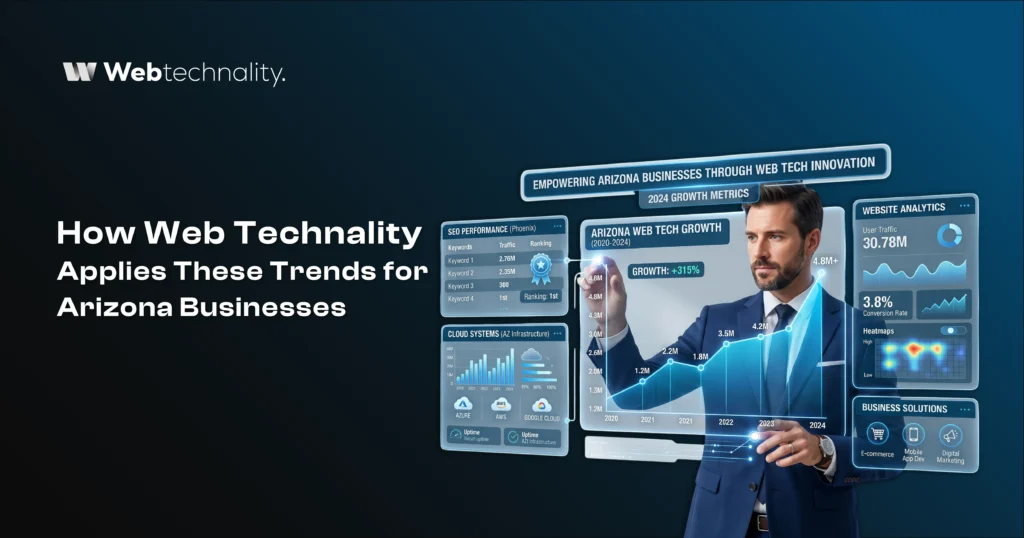
How Web Technality Applies These Trends for Arizona Businesses
At Web Technality, we do not chase trends for the sake of looking current. We study each trend critically and apply only those that best serve a specific business goal: better rankings, higher conversion rates, faster load times, or stronger brand differentiation.
Our custom web design process incorporates all of the performance, accessibility, and design standards outlined above from day one. Every website we build for Arizona businesses is fast-loading, mobile-first, SEO-optimized, and designed to convert. We build on Next.js, one of the fastest and most SEO-friendly frameworks available in 2026, and integrate AI tools where they deliver measurable ROI for our clients.
If your current website does not reflect where the industry is in 2026, it is working against you. Visitors make a judgment about your brand in under 3 seconds. An outdated or slow website signals an outdated or unreliable business, regardless of how excellent your actual services are.
Final Thoughts: Web Design Trends 2026 and What They Mean for You
The web design trends 2026 have introduced a common theme: intentionality. The best websites this year are not just visually impressive; they are fast, accessible, personalized, and strategically designed to move visitors toward a specific action. For Arizona businesses competing in local search results, these principles are the foundation of a website that ranks, converts, and grows.
The good news is that you do not need to implement every trend at once. Start with performance, fix your page speed. Then address your content structure for SEO. Add micro-interactions and personalization as your budget allows. Each improvement compounds over time into a significantly more effective digital presence.
Ready to bring your Arizona business website up to 2026 standards? Web Technality builds fast, custom, conversion-focused websites for businesses across Arizona, from Kingman to Phoenix to Tucson.
Get a Free Website SEO Audit →In 2026, Arizona businesses are shifting toward AI-driven personalization, Bento Grid layouts, and Sustainable UX. The focus is on hyper-local storytelling and kinetic typography to differentiate local brands from national competitors while reducing user cognitive load.
The 2026 design utilizes adaptive interfaces that adjust content based on the user’s location (e.g., Phoenix vs. Tucson). By reducing friction through Agentic UX, where the site predicts user needs, businesses see higher engagement and faster conversion cycles.
As voice search and AI agents become the primary way users find local services, websites must use structured Schema Markup. This allows AI to instantly pull your business data for “near me” queries, ensuring visibility in conversational search results.
Sustainable design uses leaner code and optimized assets to lower carbon footprints. For Arizona brands, this results in ultra-fast mobile performance, crucial for ranking higher in Google’s 2026 “Speed & Sustainability” metrics and improving the mobile user experience.